Advertisements
Advertisements
प्रश्न
Calculate the momentum of the following :
(a) an elephant of mass 2000 kg moving at 5 m/s
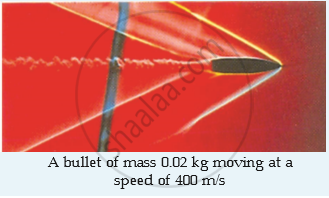
(b) a bullet of mass 0.02 kg moving at 400 m/s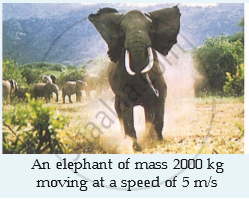
Advertisements
उत्तर
(a) We know that:
Momentum = mass × velocity
= m × v
Here, mass, m = 2000 kg
velocity, v = 5 m/s
Putting these values in the above formula, we get:
Momentum = 2000 × 5 kg.m/s = 10000 kg.m/s
(b) We know that:
Momentum = mass × velocity
= m × v
Here, mass, m = 0.02 kg
And, velocity, v = 400 m/s
Putting these values in the above formula, we get:
Momentum = 0.02 × 400 kg.m/s = 8 kg.m/s
APPEARS IN
संबंधित प्रश्न
On what factor does the inertia of a body depend ? Which has more inertia, a cricket ball or a rubber ball of the same size ?
Why do the passengers in a bus tend to fall backward when it starts suddenly ?
Explain why, a person travelling in a bus falls forward when the bus stops suddenly.
If the mass of a body and the force acting on it are both doubled, what happens to the acceleration ?
Why does a person fall when he jumps out from a moving train ?
Why does a coin, placed on a card, drop into the tumbler when the card is rapidly flicked with a finger?
What do you understand by the term inertia?
What are inertia kinds?
Passengers lean forward when a sudden brake is applied in a moving vehicle. This can be explained by ________.
A man of mass 100 kg has a weight of ______ at the surface of the Earth.
