Advertisements
Advertisements
प्रश्न
Boojho, Paheli and their friend Golu were provided with a test tube each containing China rose solution which was pink in colour. Boojho added two drops of solution ‘A’ in his test tube and got dark pink colour. Paheli added 2 drops of solution ‘B’ to her test tube and got green colour. Golu added 2 drops of solution ‘C’ but could not get any change in colour. Suggest the possible cause for the variation in their results.
Advertisements
उत्तर
A’ is an acidic solution, China rose solution turns dark pink in acids. ‘B’ is a basic solution since China's rose solution turns green in the basic solution. ‘C’ is a neutral solution hence there is no change in the colour of the China rose solution.
APPEARS IN
संबंधित प्रश्न
Give one example in the following case:
A basic oxide which is soluble in water.
Give one example in the following case:
A hydroxide which is insoluble in water.
Oxides of metals are acidic in nature.
Write any four uses of bases.
Look at figure which shows solutions taken in test tubes A, B, C and D. What colour is expected when a piece of red litmus paper is dropped in each test tube? Nature of the solutions is given in the table for your help.
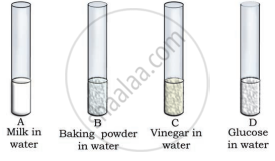
| Test tube | Nature of Solution | Change in colour of red litmus |
| A | Neutral | |
| B | Basic | |
| C | Acidic | |
| D | Neutral |
Bases are chemical substances that are corrosive and ______ in taste.
Which of the following solutions do not conduct electricity?
The nature of toothpaste commonly used is ______ in nature.
One of the events that does not occur during photosynthesis is ______.
Choose the most appropriate answer from
(SO2, SiO2, Al2O3, CO, MgO, Na2O)
A basic oxide.
