Advertisements
Advertisements
प्रश्न
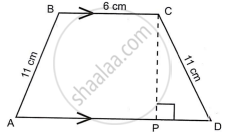
Assertion: In the trapezium ABCD, BC || AD. If AD = 8 cm, BC = 6 cm, CP = `sqrt(120)` cm and AB = 11 cm = CD then AC = 13 cm.
Reason: In a right angled triangle, (base)2 + (height)2 = (hypotenuse)2.
पर्याय
Both A and R are true and R is the correct reason for A.
Both A and R are true but R is the incorrect reason for A.
A is true but R is false.
A is false but R is true.
Advertisements
उत्तर
Both A and R are true but R is the incorrect reason for A.
Explanation:
Assertion states that in trapezium ABCD where BC || AD, given AD = 8 cm, BC = 6 cm, CP = `sqrt(120)` cm and AB = CD = 11 cm, then AC = 13 cm.
In the trapezium, by dropping perpendicular CP from C to AD, triangle ACP is a right triangle.
Given CP = `sqrt(120)` cm ...(Height)
AP = AD – DP
= 8 – 6
= 2 cm ...(Base)
By Pythagoras theorem:
AC2 = AP2 + CP2
= `2^2 + (sqrt120)^2`
= 4 + 120
= 124
So, AC = `sqrt(124)` ≈ 11.14 cm.
But since the problem states AC = 13 cm and AB = CD = 11 cm, the quadrilateral sides satisfy conditions of the trapezium.
The Reason states the Pythagoras theorem formula for a right-angled triangle:
(Base)2 + (Height)2 = (Hypotenuse)2, which is true and is used to calculate AC.
Since both the assertion and the reason are true and the reason provides the explanation for the assertion.
