Advertisements
Advertisements
प्रश्न
Assertion: In ΔABC, D is the mid point of BC. DP ⊥ AB and DQ ⊥ AC, DP = DQ. ΔBPD ≅ ΔCQD.
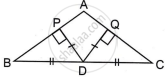
Reason: These triangles are congruent by SAS rule if 2 sides and included angle of one triangle are equal to 2 sides and included angle of the other triangle.
पर्याय
Both A and R are true and R is the correct reason for A.
Both A and R are true but R is the incorrect reason for A.
A is true but R is false.
A is false but R is true.
Advertisements
उत्तर
Both A and R are true but R is the incorrect reason for A.
Explanation:
Assertion (A):
In ΔABC, D is the midpoint of BC and DP ⊥ AB and DQ ⊥ AC.
DP = DQ.
Therefore, ΔBPD ≅ ΔCQD.
This is true because ΔBPD and ΔCQD are right-angled triangles with the hypotenuses and corresponding sides equal, satisfying the criteria for congruence Right-Angle-Hypotenuse-Side congruence or RHS.
Reason (R):
The statement says the triangles are congruent by the SAS rule Side-Angle-Side.
While RHS congruence is the correct reason here since we are dealing with right-angled triangles with hypotenuses and corresponding sides equal, SAS does not specifically apply in this case.
Thus, both the assertion and the reason are true, but R does not correctly explain the congruence rule used.
The correct congruence rule here should be RHS, not SAS.
