Advertisements
Advertisements
प्रश्न
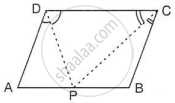
Assertion (A): In parallelogram ABCD, PD bisects ∠ADC and PC bisects angle ∠DCB; then ∠DPC = 90°.
Reason (R): `∠PDC = 1/2 xx ∠ADC`,
`∠PDC = 1/2 xx ∠BCD`,
`∠PDC + ∠PDC = 1/2 xx (∠ADC + ∠BCD)`
पर्याय
A is true, R is false.
A is false, R is true.
Both A and R are true, and R is the correct reason for A.
Both A and R are true, and R is the incorrect reason for A.
MCQ
विधान आणि तर्क
Advertisements
उत्तर
Both A and R are true, and R is the correct reason for A.
Explanation:
- Assertion (A): In parallelogram ABCD, consecutive angles ∠ADC and ∠BCD are supplementary, meaning their sum is 180°.
Since PD and PC bisect these angles respectively, we have ∠PDC = `1/2` ∠ADC and ∠PCD = `1/2` ∠BCD.
Adding them gives ∠PDC + ∠PCD = `1/2`(∠ADC + ∠BCD) = `1/2` (180°) = 90°.
In triangle PDC, the sum of angles is 180°, so ∠DPC = 180° − (∠PDC + ∠PCD) = 180° − 90° = 90°.
Thus, Assertion (A) is true. - Reason (R): The statements provided under Reason (R) correctly show that:
∠PDC = `1/2` × ∠ADC, ∠PCD = `1/2` × ∠BCD, and ∠PDC + ∠PCD = `1/2` × (∠ADC + ∠BCD), which mathematically justifies the derivation leading to the measure of ∠DPC.
Thus, Reason (R) is true and correctly explains Assertion (A).
shaalaa.com
या प्रश्नात किंवा उत्तरात काही त्रुटी आहे का?
