Advertisements
Advertisements
प्रश्न
Area of triangle ADE = 9 cm2 and area of trapezium DBCE = 16 cm2.
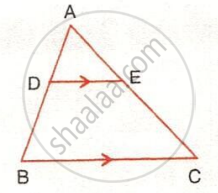
Statement (1): \[\frac{\mathrm{DE}}{\mathrm{BC}}=\frac{3}{4}\]
Statement (2): \[\frac{\triangle \mathrm{ADE}}{\triangle \mathrm{ABC}}=\frac{9}{25} \Rightarrow \frac{\mathrm{DE}}{\mathrm{BC}}=\frac{3}{5}\]
पर्याय
Both the statements are true.
Both the statements are false.
Statement 1 is true, and statement 2 is false.
Statement 1 is false, and statement 2 is true.
Advertisements
उत्तर
Statement 1 is false, and statement 2 is true.
Explanation:
Given,
Area of triangle ADE = 9 cm2 and area of trapezium DBCE = 16 cm2.
In Δ ABC and Δ ADE,
⇒ ∠BAC = ∠DAE (Common angle)
⇒ ∠ABC = ∠ADE (Corresponding angles are equal)
⇒ ∠ACB = ∠AED (Corresponding angles are equal)
∴ Δ ABC ∼ Δ ADE (By A.A.A. postulate)
From figure,
⇒ Area of triangle ABC = Area of triangle ADE + Area of trapezium DBCE = 9 + 16 = 25 cm2
We know that,
The ratio of the areas of two similar triangles is equal to the square of the ratio of their corresponding sides.
∴ `("Area of" Δ ADE)/("Area of" Δ ABC) = (DE^2)/(BC^2)`
⇒ `9/25 = (DE^2)/(BC^2)`
⇒ `(DE)/(BC) = sqrt(9/25) = 3/5`
So, statement 1 is false but statement 2 is true.
