Advertisements
Advertisements
प्रश्न
Answer the following question.
Write explanatory notes on Glycolysis.
टीपा लिहा
Advertisements
उत्तर
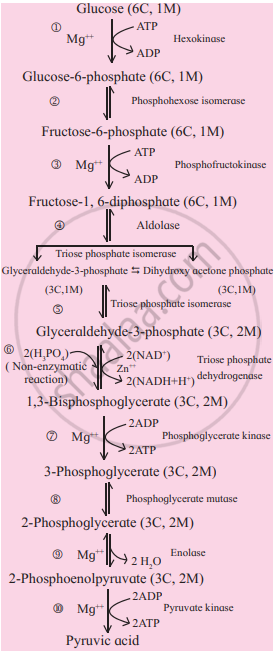
Glycolysis is a process where glucose is broken down into two molecules of pyruvic acid, hence called glycolysis (glucose-breaking). It is common to both aerobic and anaerobic respiration. It occurs in the cytoplasm of the cell. It involves ten steps.
Glycolysis consists of two major phases:
- Preparatory phase (1-5 steps):
- In this phase, glucose is phosphorylated twice by using two ATP molecules and a molecule of fructose 1,6-bisphosphate is formed.
- It is then cleaved into two molecules of glyceraldehyde-3-phosphate and dihydroxy acetone phosphate. These two molecules are 3-carbon carbohydrates (trioses) and are isomers of each other.
- Dihydroxy acetone phosphate is isomerized to the second molecule of glyceraldehyde-3-phosphate.
- Therefore, two molecules of glyceraldehyde-3- phosphate is formed.
- Preparatory phase of glycolysis ends.
- Payoff phase:
- In this phase, both molecules of glyceraldehyde-3-phosphate are converted to two molecules of 1,3- bisphoglycerate by oxidation and phosphorylation. Here, the phosphorylation is brought about by inorganic phosphate instead of ATP.
- Both molecules of 1, 3-bisphosphoglycerate are converted into two molecules of pyruvic acid through a series of reactions accompanied with the release of energy. This released energy is used to produce ATP (4 molecules) by substrate-level phosphorylation.
shaalaa.com
या प्रश्नात किंवा उत्तरात काही त्रुटी आहे का?
पाठ 13: Respiration and Energy Transfer - Exercise [पृष्ठ १५९]
