Advertisements
Advertisements
प्रश्न
Answer the following question.
How heat transfer occurs through radiation in absence of a medium?
Advertisements
उत्तर
- All objects possess thermal energy due to their temperature T(T > 0 K).
- The rapidly moving molecules of a hot body emit EM waves travelling with the velocity of light. These are called thermal radiations.
- These carry energy with them and transfer it to the low-speed molecules of a cold body on which they fall.
- This results in an increase in the molecular motion of the cold body and its temperature rises.
- Thus transfer of heat by radiation is a twofold process-the conversion of thermal energy into waves and reconversion of waves into thermal energy by the body on which they fall.
APPEARS IN
संबंधित प्रश्न
Answer the following question.
Define coefficient of thermal conductivity.
Answer the following question.
Derive its expression for the coefficient of thermal conductivity.
Answer the following question.
Explain the term thermal resistance. State its SI unit and dimensions.
Answer the following question.
Which materials can be used as thermal insulators and why?
Solve the following problem.
Which will require more energy, heating a 2.0 kg block of lead by 30 K or heating a 4.0 kg block of copper by 5 K?
(slead = 128 J kg–1 K–1, `"s"_"copper"` = 387 J kg–1 K–1)
Solve the following problem.
The rate of flow of heat through a copper rod with temperature difference 30 °C is 1500 cal/s. Find the thermal resistance of copper rod.
Solve the following problem.
Find the temperature difference between two sides of a steel plate 4 cm thick, when the heat is transmitted through the plate at the rate of 400 k cal per minute per square meter at a steady state. Thermal conductivity of steel is 0.026 kcal/m s K.
Liquid is filled in a vessel which is kept in a room with temperature 20° C. When the temperature of the liquid is 80° C, then it loses heat at the rate of 90 cal/s. What will be the rate of loss of heat when the temperature of the liquid is 40° C?
In order that the heat flows from one part of a solid to another part, what is required?
Heat energy is incident on the surface at the rate of 1000 J/min. If the coefficient of absorption is 0.8 and the coefficient of reflection is 0.1 then heat energy transmitted by the surface in 5 minutes is ______.
A slab consist of two parallel layers of copper and brass of the same thickness and having thermal conductivities in the ratio 1 : 4. If the free face of brass is at 100°C and that of copper at 0°C, the temperature of interface is ______.
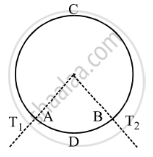
A ring consisting of two parts ADB and ACB of same conductivity K carries an amount of heat H. The ADB part is now replaced with another metal keeping the temperatures T1 and T2 constant. The heat carried increases to 2H. What should be the conductivity of the new ADB part? (Given `"ACB"/"ADB"` = 3)
A thin square steel plate with each side equal to 10 cm is heated by a blacksmith. The rate of radiated energy by the heated plate is 1134 watts. The temperature of the hot steel plate is ______.
(Stefan's constant σ = 5.67 × 10⁻⁸ watt m-2K-4 emissivity of the plate = 1)
An electric heater is used in a room with a total wall area of 137 m2 to maintain a temperature of +20°C inside it when the outside temperature is -10°C. The walls have three different layers of materials. The innermost layer is of wood of thickness 2.5 cm, the middle layer is of cement of thickness 1.0 cm and the outermost layer is brick of 25.0 cm. The power of the electric heater will be ______ W. Assume that there is no heat loss through the floor and the ceiling. The thermal conductivities of wood, cement, and brick are 0.125, 1.5, and 1.0 watt/m/°C respectively.
Two metallic blocks M1 and M2 of same area of cross-section are connected to each other (as shown in figure). If the thermal conductivity of M2 is K then the thermal conductivity of M1 will be ______. [Assume steady state heat conduction]

In the amount of water of mass 20 g at 0°C is mixed with 40 g of water at 10°C, the final temperature of the mixture is ______.
Two rods of the same material, same length and same radius transfer a given amount of heat in t second when they are joined end-to-end. When the rods are joined one above the other, then they will transfer the same heat in the same conditions in time ______.
Through which mode does heat transfer take place in solids?
In which mode of heat transfer do the molecules physically move from one place to another?
At what speed do electromagnetic waves travel in space during radiation?
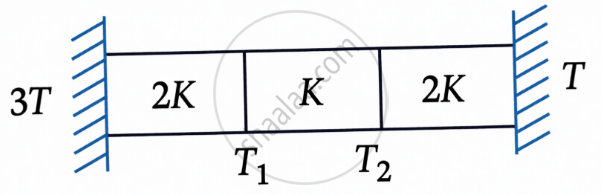
Three identical heat conducting rods are connected in series as shown in the figure. The rods on the sides have thermal conductivity 2K while that in the middle has thermal conductivity K. The left end of the combination is maintained at temperature 3T and the right end the at T. The rods are thermally insulated from outside. In steady state, temperature at the left junction is T1 and that the right junction is T2. The ratio T1/2 T is: