Advertisements
Advertisements
प्रश्न
Answer the following.
Distinguish between transparent, translucent, and opaque objects.
Advertisements
उत्तर
- Transparent objects: Those objects through which light can pass easily are called transparent objects, e.g. Water, glass, air.
- Translucent object: The object through which light can pass partially are called translucent object, e.g. tracing paper, waxed paper.
- Opaque object: The objects which do not allow the light to pass through are called opaque objects, e.g. wood.
APPEARS IN
संबंधित प्रश्न
Write true or false of the following statement.
A shadow is formed because light travels in a straight-line path.
Name two natural sources of light.
List two artificial sources of light.
Fill in the blank
The brightness of light is measured in ...................
Write true or false
The stars have no light.
When light passes through a prism, it gets separated into ______ colours.
When a ______ object comes in the way of light, light passes ______ it.
The path of the light is called as ______.
Light is a form of energy and it travels in a straight line.
Look at the figure given in the following figure.
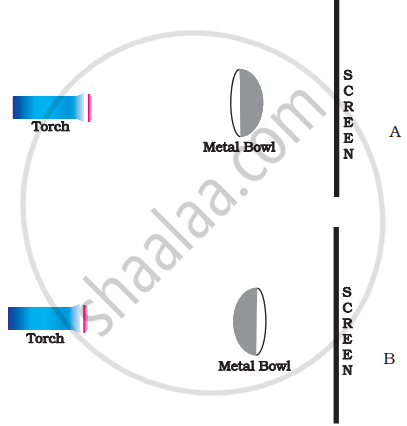
Will there be any difference in the shadow formed on the screen in A and B.
