Advertisements
Advertisements
प्रश्न
An object AB is placed on the principal axis of a convex lens as shown in the diagram.
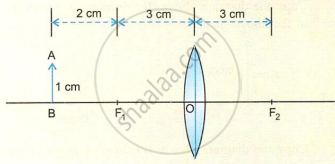
Copy the diagram according to dimensions.
- From point A draw a ray passing through optical centre and then to the other side of lens.
- From point A draw a ray parallel to principal axis and then its passage through convex lens after refraction.
- From point A draw another ray passing through F₁ and then through lens after refraction.
- Locate the position of image.
- State two characteristics of image.
Advertisements
उत्तर
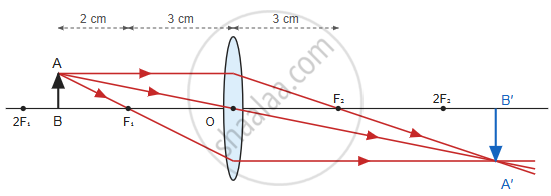
(a) The ray from A through the optical centre O goes straight through without bending.
(b) The ray from A parallel to the principal axis bends at the lens and passes through F₂.
(c) The ray from A through F₁ comes out of the lens parallel to the principal axis.
(d) The three rays meet at A′, below the axis, beyond 2F₂ on the other side of the lens. The image A′B′ is formed there, 7.5 cm from the lens and 1.5 cm high.
The lens formula confirms this:
\[ \frac{1}{v} - \frac{1}{u} = \frac{1}{f} \]
\[ \Rightarrow \frac{1}{v} - \frac{1}{-5} = \frac{1}{3} \]
\[ \Rightarrow \frac{1}{v} = \frac{1}{3} - \frac{1}{5} = \frac{2}{15} \]
\[ \Rightarrow v = + \ 7.5 \ \text{cm} \]
\[ m = \frac{v}{u} = \frac{7.5}{-5} = - \ 1.5 \]
(e) Two characteristics of the image:
- Real and Inverted: The image is formed by the actual intersection of refracted light rays and points downwards below the principal axis.
- Magnified: The size of the image is larger than the object (Height = 1.5 cm, compared to the 1 cm object height).
