Advertisements
Advertisements
प्रश्न
An erect and enlarged image can be formed by
पर्याय
only a convex mirror.
only a concave mirror.
only a plane mirror.
both convex and concave mirrors.
Advertisements
उत्तर
only a concave mirror.
Expalantion:
Concave mirror forms a virtual, erect and enlarged image.
APPEARS IN
संबंधित प्रश्न
Consider the following diagram in which M is a mirror and P is an object and Q is its magnified image formed by the mirror.
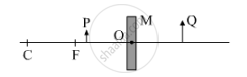
State the type of the mirror M and one characteristic property of the image Q.
A spherical mirror produces an image of magnification -1.0 on a screen placed at a distance of 30 cm from the pole of the mirror.
(i) Write the type of mirror in this case.
(ii) What is the focal length of the mirror ?
(iii) What is the nature of the image formed ?
(iv) Draw the ray diagram to show the image formation in this case.
Explain why, a ray of light passing through the centre of curvature of a concave mirror gets reflected back along the same path.
Which mirror is used as a torch reflector? Draw a labelled diagram to show how a torch reflector can be used to produce a parallel beam of light. Where is the bulb placed in relation to the torch reflector?
Briefly describe how you would find the focal length of a concave mirror quickly but approximately
One of the following does not apply to a concave mirror this is:
(a) focal length is negative
(b) image distance can be positive or negative
(c) image distance is always positive
(d) height of image can be positive or negative
A large concave mirror has a radius of curvature of 1.5 m. A person stands 10 m in front of the mirror. Where is the person's image?
A concave mirror produces three times enlarged virtual image of an object placed at 10 cm in front of it. Calculate the radius of curvature of the mirror.
How far should an object be placed from the pole of a converging mirror of focal length 20cm to form a real image of the size exactly `1/4`th the size of the object?
Concave mirrors are used by dentists to examine teeth. Why?
