Advertisements
Advertisements
प्रश्न
An empty glass bottle is fitted with a narrow tube at its mouth. The open end of the tube is kept in a beaker containing water. When the bottle is heated, bubbles of air are seen escaping into water. Explain the reason.
Advertisements
उत्तर
When the bottle is heated, the air in it expands and the solubility of gases in it decreases which escapes from water in the form of bubbles.
APPEARS IN
संबंधित प्रश्न
What is matter? What is it composed of?
Give scientific reason.
An ordinary glass bottle cracks when boiling water is poured into it, but a borosil glass bottle does not.
Give reasons for the following:
Telephone wires sag in summer.
Give reasons for the following:
In cold countries, water pipes burst in winter.
The diagram shows a sketch graph showing a change in volume of a given mass of ice at -5°C to water at 15°C.
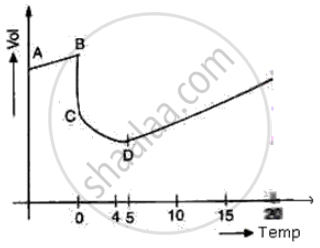
(i) Why does the temperature along BC remain constant?
(ii) When is the volume of water minimum?
(iii) At what temperature does water have maximum density? Explain.
Analogy:
Ordinary glass:: Glass tumbler.
Pyrex glass:: ______.
How solids are expanded on heating?
When the vibrations move from one molecule to another molecule heat will flow.
