Advertisements
Advertisements
प्रश्न
An atom changes to a charged particle called ion if it loses or gains electrons. The charge on an ion is the charge on electrons plus charge on protons. Now, write the missing information in the table given below:
| Name of Ion | Proton Charge | Electron Charge | Ion Charge |
| Hydroxide ion | +9 | – | –1 |
| Sodium ion | +11 | – | +1 |
| Aluminium ion | +13 | –10 | – |
| Oxide ion | +8 | –10 | – |
Advertisements
उत्तर
Hydroxide ion charge = Proton charge + Electron charge
`\implies` –1 = +9 + Electron charge
`\implies` Electron charge = –1 – 9 = –10
Sodium ion charge = Proton charge + Electron charge
`\implies` +1 = +11 + Electron charge
`\implies` Electron charge = +1 – 11 = –10
Aluminium ion charge = Proton charge + Electron charge
`\implies` +13 + (–10) = +13 – 10 = +3
Oxide ion charge = Proton charge + Electron charge
`\implies` +8 + (–10) = +8 – 10 = –2
APPEARS IN
संबंधित प्रश्न
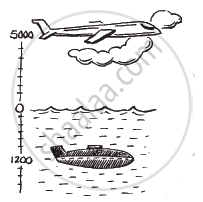
A plane is flying at the height of 5000 m above the sea level. At a particular point, it is exactly above a submarine floating 1200 m below the sea level. What is the vertical distance between them?
Write the proper sings >, < or = in the boxes below.
| (1) –4 `square` 5 | (2) 8 `square` –10 | (3) +9 `square` +9 | (4) –6 `square` 0 |
| (5) 7 `square` 4 | (6) 3 `square` 0 | (7) –7 `square` 7 | (8) –12 `square` 5 |
| (9) –2 `square` –8 | (10) –1 `square` –2 | (11) 6 `square` −3 | (12) –14 `square` –14 |
Write the opposite of the following: 5°C below the freezing point
Subtract: −135 from −250
Multiply: 29 by −11
Use convenient groupings and find the value of: (−17) × (−23) × 41
(−7) + (−9) + 12 + (−16) = ?
On subtracting −9 from −6, we get
Write two integers which are smaller than –6 but their difference is greater than –6.
Represent the following numbers as integers with appropriate signs.
Withdrawal of rupees seven hundred.
