Advertisements
Advertisements
प्रश्न
AM = MB, ∠AOB = 140°
∠OAM =
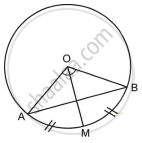
पर्याय
50°
55°
60°
45°
Advertisements
उत्तर
55°
Explanation:
1. Known facts:
- AM = MB → M is the midpoint of chord AB.
- ΔOAB is isosceles (OA = OB, both radii).
- ∠AOB = 140°.
- We want ∠OAM.
2. First, find ∠OAB in ΔOAB:
∠OAB = ∠OBA
= `(180^circ - 140^circ)/2`
= 20°
3. Now, locate M and think about ΔOAM:
M lies on chord AB such that AM = MB.
This does not mean OM bisects ∠AOB, because M is not necessarily the midpoint of the arc only of the chord.
4. Use triangle properties:
In ΔOAM, side OA = radius r and AM is half of AB.
From ΔOAB, we can use the sine rule or cosine rule to get OM, then find ∠OAM.
5. Calculation:
In ΔOAB:
By cosine rule:
`AB = sqrt(OA^2 + OB^2 - 2 * OA * OB * cos 140^circ)`
= `sqrt(r^2 + r^2 - 2r^2 cos 140^circ)`
= `rsqrt(2 - 2 cos 140^circ)`
cos 140° = – cos 40° ≈ – 0.7660
So:
`AB = rsqrt(2 - 2(-0.7660))`
= `rsqrt(2 + 1.532)`
= `rsqrt(3.532) ≈ 1.879r`
Half of this:
`AM = (AB)/2 ≈ 0.9395r`
6. In ΔOAM:
Sides: OA = r, AM ≈ 0.9395r
We also know OM is from midpoint, so use cosine rule again:
OM2 = OA2 – AM2 + (something?) (instead, easier to use sine rule in OAB)
Better: In ΔOAB, median OM length is given by Apollonius theorem:
`OM^2 = (OA^2 + OB^2)/2 - (AB)^2/4`
= `(r^2 + r^2)/2 - (1.879r)^2/4`
= `r^2 - (3.532r^2)/4`
= r2 – 0.8832r2
= 0.117r2
OM ≈ 0.3417r
7. Now find ∠OAM in ΔOAM:
By sine rule:
`(sin ∠OAM)/(OM) = (sin ∠AOM)/(AM)`
We know ∠AOM = 70° (half of 140°), so:
`(sin ∠OAM)/(0.3417r) = (sin 70^circ)/(0.9395r)`
Cancel r:
`sin ∠OAM = 0.3417 * (sin 70^circ)/0.9395`
sin 70° ≈ 0.9397, so:
sin ∠OAM ≈ 0.3417 · 1.0002 ≈ 0.3418
This gives ∠OAM ≈ 55°.
