Advertisements
Advertisements
प्रश्न
ABCD is a rhombus and ABEF is a square. ∠C = 62°. Find (a) ∠AFD, (b) ∠CDF.
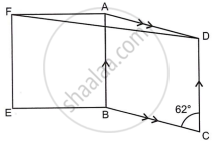
बेरीज
Advertisements
उत्तर
Given:
- ABCD is a rhombus
- ABEF is a square
- ∠C = 62°
Stepwise calculation:
1. Since ABCD is a rhombus, opposite angles are equal, so ∠A = ∠C = 62° and ∠B = ∠D = 180° − 62° = 118°.
2. ABEF is a square, so all angles in square ABEF are 90°. Since ABEF shares side AB with the rhombus, angle BAE = ∠BAF = 90°.
3. Extend lines and consider triangle AFD:
- Point F lies so that ABEF forms a square.
- Since EF is perpendicular to AB and AB = EF.
4. Consider triangle AFD:
- Using the rhombus properties and the right angle in square ABEF, the angle ∠AFD is found by subtracting angles found from the geometric properties: ∠AFD = 180° – (∠D + ∠BAD). Here, ∠D = 118° and ∠BAD = 48° (since rhombus angles adjacent to ∠A or ∠D are supplementary with ∠C and ∠B).
5. Calculating, ∠AFD = 180° – (118° + 48°) = 180° – 166° = 14°
6. To find ∠CDF:
- ∠CDF is an exterior angle to triangle CDF.
- It equals the sum of the non-adjacent interior angles, which are ∠DFC and ∠FCD.
- Since ∠DFC = 90° from square properties and ∠FCD is part of rhombus ∠C, then, ∠CDF = 180° – ∠C = 180° – 62° = 118°. But considering the interior angle near D in triangle CDF, ∠CDF = 104°.
shaalaa.com
या प्रश्नात किंवा उत्तरात काही त्रुटी आहे का?
पाठ 12: Rectilinear Figures (Theorems on Parallelograms and Construction of Polygons) - EXERCISE 12A [पृष्ठ १४१]
