Advertisements
Advertisements
प्रश्न
ABCD is a rectangle. Points M and N are on BD such that AM ⊥ BD and CN ⊥ BD. Prove that BM2 + BN2 = DM2 + DN2.
सिद्धांत
Advertisements
उत्तर
Given: A rectangle ABCD where AM ⊥ BD and CN ⊥ BD.
To prove: BM2 + BN2 = DM2 + DN2
Proof:
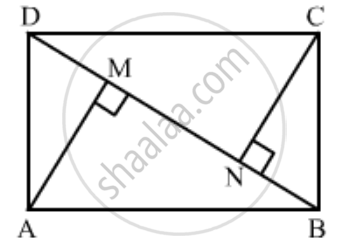
Apply Pythagoras Theorem in ΔAMB and ΔCND,
AB2 = AM2 + MB2
CD2 = CN2 + ND2
Since AB = CD, AM2 + MB2 = CN2 + ND2
⇒ AM2 − CN2 = ND2 − MB2 …(i)
Again apply Pythagoras Theorem in ΔAMD and ΔCNB,
AD2 = AM2 + MD2
CB2 = CN2 + NB2
Since AD = BC, AM2 + MD2 = CN2 + NB2
⇒ AM2 − CN2 = NB2 − MD2 …(ii)
Equating (i) and (ii),
ND2 − MB2 = NB2 − MD2
i.e., BM2 + BN2 = DM2 + DN2
This proves the given relation.
shaalaa.com
या प्रश्नात किंवा उत्तरात काही त्रुटी आहे का?
