Advertisements
Advertisements
प्रश्न
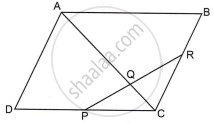
ABCD is a parallelogram. P is the mid-point of DC and Q is a point on AC such that CQ = `1/4` AC. PQ produced meets BC at R. Prove that R is the mid-point of BC. [Hint: Join DB.]
Advertisements
उत्तर
Given:
- ABCD is a parallelogram.
- P is the midpoint of side DC,
- Q is a point on diagonal AC such that CQ = `1/4` AC,
- PQ is produced to meet BC at point R,
- We need to prove that R is the midpoint of side BC.
Step 1: Analyze the geometry and use the midpoint theorem
Since ABCD is a parallelogram, we know the following:
- Opposite sides of a parallelogram are equal and parallel, so:
- AB = DC,
- AD = BC,
- AC and BD are diagonals that bisect each other at the midpoint and O is the midpoint of both diagonals.
Step 2: Introduce the midpoint theorem and proportionality
- P is the midpoint of DC, so DP = PC.
- Q divides AC such that CQ = `1/4` AC, which means AQ = `3/4` AC.
Next, let’s use the properties of the parallelogram and consider the line PQ. The line joining the midpoints of two sides of a parallelogram is parallel to the third side and half its length. So, if we extend the line PQ, it will intersect BC at point R and we need to prove that R is the midpoint of BC.
Step 3: Join diagonal DB and use the properties of intersecting lines
Join diagonal DB, which intersects the line AC at its midpoint (since diagonals of a parallelogram bisect each other).
The line PQ is produced to meet BC at point R. By symmetry and the fact that both P and Q divide the sides of the parallelogram in a certain ratio, we can conclude that R divides BC in half.
Step 4: Apply proportionality and conclude that R is the midpoint of BC
Using the properties of similar triangles and the midpoint theorem, we can deduce that R divides BC into two equal parts. This shows that R is indeed the midpoint of BC.
