Advertisements
Advertisements
प्रश्न
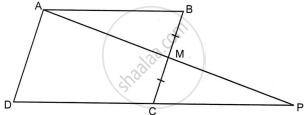
ABCD is a parallelogram. M is the midpoint of BC. Show that DC = CP. [Hint: Prove that ΔABM ≅ ΔPCM]
Advertisements
उत्तर
Given:
ABCD is a parallelogram.
M is the midpoint of BC.
To Prove: DC = CP
Proof:
Step 1: Show that △ABM ≅ △PCM
To prove the congruence of triangles △ABM and △PCM, we need to check for congruence using a valid criterion in this case, SAS (Side-Angle-Side).
1.1: Side 1, AB = PC
In parallelogram ABCD, opposite sides are equal.
Hence, AB = CD and PC = CD.
Thus, AB = PC.
1.2: Side 2, BM = CM
Since M is the midpoint of BC, we have BM = CM.
1.3: Angle, ∠ABM = ∠PCM
In a parallelogram, consecutive angles are supplementary.
So, ∠ABM = ∠PCM.
This is because both are adjacent to the same pair of parallel lines, AB || DC.
Step 2: Apply SAS Congruence
Since:
AB = PC
BM = CM
∠ABM = ∠PCM
We can conclude by the SAS congruence criterion that △ABM ≅ △PCM.
Step 3: DC = CP
From the congruence of triangles △ABM and △PCM, we know that corresponding parts of congruent triangles are equal.
Therefore, DC = CP.
Hence, it is proved that DC = CP.
