Advertisements
Advertisements
प्रश्न
ABCD is a parallelogram, E and F are the midpoints of AB and CD respectively. GH is any line that intersects AD, EF and BC in G, P and H respectively. Prove that GP = PH.
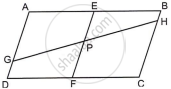
[Hint: Use Intercept Theorem on AD || EF || BC.]
Advertisements
उत्तर
Given:
- ABCD is a parallelogram,
- E and F are the midpoints of sides AB and CD, respectively.
- GH is a line that intersects AD, EF and BC at points G, P and H, respectively.
We are asked to prove that GP = PH.
Step 1: Use the Intercept Theorem (or Thales’ Theorem)
The Intercept Theorem states that if a transversal intersects two parallel lines, then it divides the segment between the two parallel lines into segments that are proportional to the corresponding segments of the other line.
In our case:
- AD || BC || EF,
- The line GH intersects the three parallel lines at points G, P and H.
Step 2: Apply the Intercept Theorem
Since AD || BC || EF, we can apply the Intercept Theorem on the line GH, which intersects the three parallel lines.
By the Intercept Theorem, the segments created by the intersection of GH with AD, EF and BC are proportional. Specifically, the segments GP and PH (formed by GH intersecting AD and BC) are proportional to the lengths of the corresponding segments between the parallel lines.
Thus, applying the theorem, we get:
`(AG)/(GD) = (EP)/(PF) = (BH)/(HC)`
Step 3: Prove that GP = PH
Since E and F are the midpoints of AB and CD, respectively, we know that:
- EF is parallel to both AD and BC,
- E and F divide AB and CD into equal segments.
This implies that the line GH divides the segment AD into two equal parts and similarly divides the segment BC into two equal parts. Consequently, the length of segment GP equals the length of segment PH.
Thus, GP = PH.
