Advertisements
Advertisements
प्रश्न
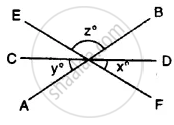
AB, CD and EF are three lines intersecting at the same point.
(i) Find x, if y = 45° and z = 90°.
(ii) Find a, if x = 3a, y = 5x and r = 6x.
Advertisements
उत्तर
AB, CD and EF are intersecting each other at O.
and ∠DOF = x°, ∠AOC = y°
and ∠BOE = z°
But ∠DOB = ∠AOC = y° ...............(Vertically opposite angles)
Similarly, ∠COE = ∠DOF = x°
and ∠AOF = ∠BOE = z°
∴ CD is a straight line
∴ ∠COE + ∠BOE + ∠DOE = 180°
⇒ x° + z° + y° = 180°
⇒ x° + y° + z° = 180°
(i) If y = 45°, and z = 90°, then
⇒ x° + 45° + 90° = 180°
⇒ x° + 135° = 180°
∴ x° = 180°− 135° = 45°
(ii) If x = 3a, y = 5x, z = 6x,
then x + y + z = 180°
⇒ x + 5x + 6x = 180°
⇒ 12x = 180°
⇒ x = `(180°)/12` = 15°
But x = 3a
∴ 3a = 15°
⇒ a = `(15°)/3` = 5°
Hence a = 5°
APPEARS IN
संबंधित प्रश्न
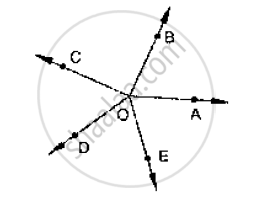
In the given below fig, rays OA, OB, OC, OP and 0E have the common end point O. Show
that ∠AOB + ∠BOC + ∠COD + ∠DOE + ∠EOA = 360°.
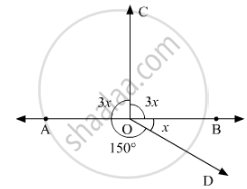
In below fig, determine the value of x.
Define complementary angles.
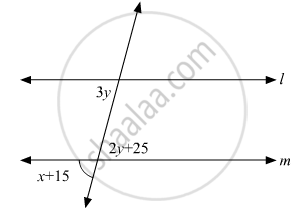
In the given figure, if l || m, what is the value of x?
State, true or false:
Is 40° the complement of 60°?
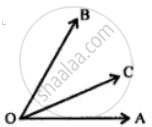
In the following figure, ∠AOB and ∠AOC are adjacent angles? Give the reason for your answer.
Write the complement of `1/3` of 180°
Write the supplement of (x + 35)°
Write the supplement of (110 – x – 2y)°
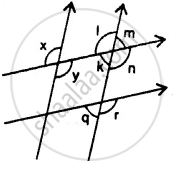
In the given figure, the arrows indicate parallel lines. State which angles are equal. Give a reason.