Advertisements
Advertisements
प्रश्न
A tall cylinder is filled with viscous oil. A round pebble is dropped from the top with zero initial velocity. From the plot shown in figure, indicate the one that represents the velocity (v) of the pebble as a function of time (t).
पर्याय
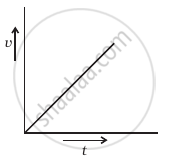
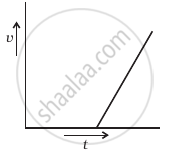
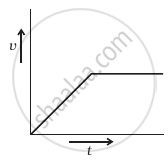
Advertisements
उत्तर
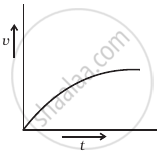
Explanation:
In fluids, when the pebble is dropped from the top of a tall cylinder filled with viscous oil, a variable force called viscous force will act which increases with an increase in speed. And at equilibrium this velocity becomes constant, that constant velocity is called terminal velocity.
When the pebble is falling through the viscous oil, the viscous force is F = 6πηrv
Where r is the radius of the pebble, v is instantaneous speed, η is the coefficient of viscosity. As the force is variable, hence acceleration is also variable so the v-t graph will not be a straight line. First velocity increases and then becomes constant known as terminal velocity.
APPEARS IN
संबंधित प्रश्न
A solid sphere falls with a terminal velocity of 20 m s−1 in air. If it is allowed to fall in vacuum,
A solid sphere moves at a terminal velocity of 20 m s−1 in air at a place where g = 9.8 m s−2. The sphere is taken in a gravity-free hall having air at the same pressure and pushed down at a speed of 20 m s−1.
(a) Its initial acceleration will be 9.8 m s−2 downward.
(b) It initial acceleration will be 9.8 m s−2 upward.
(c) The magnitude of acceleration will decrease as the time passes.
(d) It will eventually stop
Two spheres of equal masses but radii r1 and r2 are allowed to fall in a liquid of infinite column. The ratio of their terminal velocities are ____________.
A drop of radius 1.5 x 10⁻⁵ and density 2 x 10³ kg/m3 falls through air. The viscosity of air is 1.8 x 10⁻⁵ N s/m2. Neglecting buoyancy due to air, the terminal speed of the drop is ____________.
A drop of radius 4 x 10⁻⁵ m and density 2.5 x 10³ kg/m3 falls through air. The viscosity of air is 1.96 x 10⁻⁵ N s/m2 . Neglecting buoyancy due to air, the terminal speed of the drop is ____________.
Two small spherical metal balls, having equal masses, are made from materials of densities `rho_1` and`rho_2 (rho_1 = 8rho_2)` and have radii of 1 mm and 2 mm, respectively, they are made to fall vertically (from rest) in a viscous medium whose coefficient of viscosity equals `eta` and whose density is `0.1rho_2` The ratio of their terminal velocities would be, ____________.
Eight identical drops of water falling through air with uniform velocity of 10 cm/s combine to form a single drop of big size, then terminal velocity of the big drop will be ______.
The radii of the two spheres P and Q of same material falling in the viscous liquid are in the ratio 3 : 2, their terminal velocities (P to Q) are in the ratio ______.
A small spherical solid ball is dropped from a great height in a viscous liquid. Its journey in the liquid is best described in the diagram given below by the ____________.

Two drops of equal size are falling vertically through the air with a constant terminal velocity of 0.15 cm/s. What should be the velocity, if these drops coalesce to form one drop?
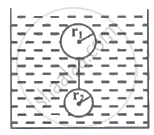
Two solid spherical balls of radius r1 and r2 (r2 < r1), of density σ are tied up with a long string and released in a viscous liquid column of lesser density ρ and coefficient of viscosity η, with the string just taut as shown. The terminal velocity of spheres is ______.
A spherical ball of iron of radius 2 mm is falling through a column of glycerine. If densities of glycerine and iron are respectively 1.3 × 10³ kg/m3 and 8 × 10³ kg/m3. η for glycerine = 0.83 Nm-2 sec, then the terminal velocity is ______.
Two equal drops of water are falling through air with a steady velocity v. If the drops coalesce, the new velocity will be ______.
Two solid spheres of same metal but of mass M and 64 M fall simultaneously through a viscous liquid and their terminal velocities are V and nV respectively then value of n is ______.
Eight equal drops of water are falling through air with a steady speed of 10 cm/s. If the drops coalesce, the new velocity is ______.
Two spheres of the same material but of radii R and 3 R are allowed to fall vertically downwards through a liquid of density σ. The ratio of their terminal velocities is:
