Advertisements
Advertisements
प्रश्न
A student wants to project the image of a candle flame on a screen 80 cm in front of a mirror by keeping the candle flame at a distance of 20 cm from its pole.
- Which type of mirror should the student use?
- Find the magnification of the image produced.
- Find the distance between the object and its image.
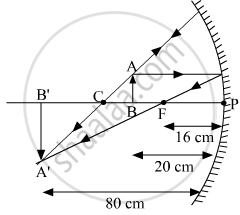
- Draw a ray diagram to show the image formation in this case and mark the distance between the object and its image.
Advertisements
उत्तर
(a) A real image can be projected on a screen using a concave mirror. In the given case, the student should use a concave mirror.
(b) \[\text{ Magnification }\left( m \right)\text{ is given by }\]
\[m = - \frac{v}{u}\]
Here,
\[u = \text{ Distance of the object }\]
\[v =\text{ Distance of the image }\]
\[ \therefore m = \frac{- \left( - 80 \right)}{\left( - 20 \right)} = - 4\]
(c)
The object and the image are on the same side of the mirror.
Distance of the object from the lens = 20 cm
Distance of the image from the lens = 80 cm
Thus,
Distance between the object and the image = 80 − 20 = 60 cm
(d)
To draw a ray diagram, we need to find the focal length of the mirror.
According to the mirror formula,
\[\frac{1}{f} = \frac{1}{u} + \frac{1}{v}\]
Here,
u = Distance of the object
v = Distance of the image
f = Focal length of the mirror
Now,
\[\frac{1}{f} = \frac{1}{- 20} + \frac{1}{- 80}\]
\[ \Rightarrow \frac{1}{f} = - \left( \frac{4 + 1}{80} \right)\]
\[ \Rightarrow \frac{1}{f} = - \left( \frac{5}{80} \right)\]
\[ \Rightarrow f = - \left( \frac{80}{5} \right) = - 16 cm\]