Advertisements
Advertisements
प्रश्न
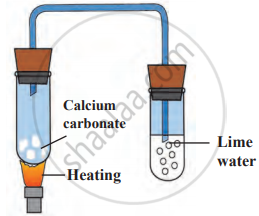
A solid substance P which is very hard is used in the construction of many buildings, especially flooring. When substance P is heated strongly, it decomposes to form another solid Q and a gas R is given out. Solid Q reacts with water with the release of a lot of heat to form a substance S. When gas R is passed into a clear solution of substance S, then a white precipitate of substance T is formed. The substance T has the same chemical composition as starting substance P.
- What is substance P? Write its common name as well as chemical formula.
- What is substance Q?
- What is gas R?
- What is substance S? What is its clear solution known as?
- What is substance T? Name any two natural forms in which substance T occurs in nature.
Advertisements
उत्तर
- Substance P is calcium carbonate. Its common name is limestone, and its chemical formula is CaCO3.
- Substance Q is calcium oxide (CaO).
- Gas R is carbon dioxide gas (CO2).
- Substance S is calcium hydroxide [Ca(OH)2]. Its clear solution is known as lime water.
- Substance T is calcium carbonate (CaCO3). Two natural forms of calcium carbonate are calcite and mollusc shell.
APPEARS IN
संबंधित प्रश्न
What does one mean by exothermic reaction? Give example.
Why are decomposition reactions called the opposite of combination reactions? Write equations for these reactions.
Give one example of a decomposition reaction which is carried out with electricity.
What type of chemical reaction takes place when silver bromide is exposed to sunlight?
What type of reaction is represented by the following equation?
\[\ce{NH4NO2 -> N2 + 2H2O}\]
What is meant by a decomposition reaction?
State the change in colour observed in the following case, mentioning the reason:
Silver chloride is exposed to sunlight.
When a green iron salt is heated strongly, its colour finally changes to brown and odour of burning sulphur is given out.
- Name the iron salt.
- Name the type of reaction that takes place during the heating of iron salt.
- Write a chemical equation for the reaction involved.
Classify the following reaction as combination, decomposition, displacement, precipitation and neutralization. Also balance the equation.
\[\ce{Zn_{(s)} + H2SO4 -> ZnSO4_{(s)} + H2_{(g)}}\]
What are thermal decomposition reactions ? Explain with an example.
Give a scientific reason.
When the gas formed on heating limestone is passed through freshly prepared lime water, the lime water turns milky.
Identify the type of following reaction :

A student wants to study a decomposition reaction by taking ferrous sulphate crystals. Write two precautions he must observe while performing the experiment.
Give a balanced equation for –
A double decomposition neutralization reaction involving an acid and a base
Differentiate between the following:
Electrolytic decomposition and photochemical decomposition.
Explain the reaction given in the figure.
Which of the following is an endothermic process?
When SO2 gas is passed through a saturated solution of H2S, which of the following reaction occurs?
When lead nitrate is heated strongly in a boiling tube, two gases are liberated and a solid residue is left behind in the test tube.
- Name the type of chemical reaction and define it.
- Write the name and formula of the coloured gas liberated.
- Write the balanced chemical equation for the reaction.
- Name the residue left in the test tube and state the method of testing its nature (acidic/basic).
