Advertisements
Advertisements
प्रश्न
A solid sphere is cut into two identical hemispheres.
Statement 1: The total volume of two hemispheres is equal to the volume of the original sphere.
Statement 2: The total surface area of two hemispheres together is equal to the surface area of the original sphere.
Which of the following is valid?
पर्याय
Both the statements are true.
Both the statements are false.
Statement 1 is true and Statement 2 is false.
Statement 1 is false and Statement 2 is true.
Advertisements
उत्तर
Statement 1 is true and Statement 2 is false.
Explanation:
Statement 1: The total volume of two hemispheres is equal to the volume of the original sphere.
The volume V of a sphere with radius r is given by:
`V = 4/3πr^3`
When a sphere is cut into two hemispheres, each hemisphere will have half the volume of the original sphere.
Therefore, the volume of one hemisphere is:
`V_("hemisphere") = 1/2 xx 4/3πr^3 = 2/3πr^3`
Since there are two hemispheres, the total volume of the two hemispheres is:
This is equal to the volume of the original sphere.
Thus, Statement 1 is true.
Statement 2: The total surface area of two hemispheres together is equal to the surface area of the original sphere.
The surface area A of a sphere with radius r is given by:
A = 4πr2
When the sphere is cut into two hemispheres, each hemisphere will have:
- A curved surface area: 2πr2
- A flat circular base area: πr2
The total surface area of one hemisphere is:
`V_("hemisphere") = 2πr^2 + πr^2 = 3πr^2`
Since there are two hemispheres, the total surface area of the two hemispheres is:
2 × 3πr2 = 6πr2
This is more than the surface area of the original sphere, which is 4πr2.
The additional area comes from the flat circular bases of the hemispheres.
Thus, Statement 2 is false.
APPEARS IN
संबंधित प्रश्न
Find the surface area of a sphere of diameter 3.5 m.
`["Assume "pi=22/7]`
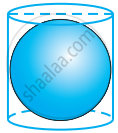
A right circular cylinder just encloses a sphere of radius r (see figure). Find
- surface area of the sphere,
- curved surface area of the cylinder,
- ratio of the areas obtained in (i) and (ii).
The volume of a sphere is 38808 cm3; find its diameter and the surface area.
If the number of square centimeters on the surface of a sphere is equal to the number of cubic centimeters in its volume, what is the diameter of the sphere?
Metallic spheres of radii 6 cm, 8 cm and 10 cm respectively are melted and recasted into a single solid sphere. Taking π = 3.1, find the surface area of the solid sphere formed.
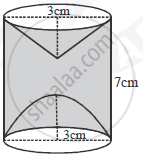
A hemispherical and a conical hole is scooped out of a.solid wooden cylinder. Find the volume of the remaining solid where the measurements are as follows:
The height of the solid cylinder is 7 cm, radius of each of hemisphere, cone and cylinder is 3 cm. Height of cone is 3 cm.
Give your answer correct to the nearest whole number.Taken`pi = 22/7`.
A certain number of metallic cones, each of radius 2 cm and height 3 cm are melted and recast into a solid sphere of radius 6 cm. Find the number of cones used.
How many spherical bullets can be made out of a solid cube of lead whose edge measures 44 cm, each bullet being 4 cm in diameter?
A vessel is in he form of an inverted cone. Its height is 11 cm., and the radius of its top which is open is 2.5 cm. It is filled with water up to the rim. When lead shots, each of which is a sphere of radius 0.25 cm., are dropped 2 into the vessel, `2/5`th of the water flows out. Find the number of lead shots dropped into the vessel.
The internal and external diameters of a hollow hemispherical vessel are 20 cm and 28 cm respectively. Find the cost to paint the vessel all over at ₹ 0.14 per cm2
