Advertisements
Advertisements
प्रश्न
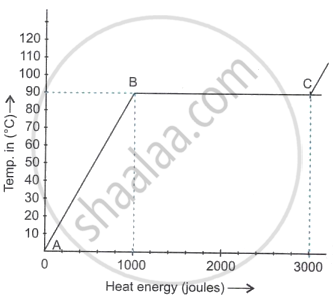
A solid initially at 0°C is heated. The graph shows the variation in temperature with the amount of heat energy supplied. If the specific heat capacity of the solid is 0.6 Jg−1°C−1, from the graph calculate the (a) mass of solid (b) sp. latent heat of fusion of solid.
संख्यात्मक
Advertisements
उत्तर
(a) The part AB of the graph shows the solid state when the temperature rises from 0 to 90°.
Heat absorbed by the solid (H) = mcθR
⇒ 1000 J = m × 0.6 Jg−1°C−1 × 90°С
\[\therefore m=\frac{1000}{0.6 \times 90} \mathrm{~g}\]
= 18.5 g
(b) The part of BC of the graph shows the change of state of solid into liquid.
∴ Heat absorbed (H) = mL
⇒ (3000 – 1000) J = 18.5 g × L
\[\therefore L = \frac{2000}{18.5} \mathrm{Jg}^{-1}\]
= 108.1 Jg−1
shaalaa.com
या प्रश्नात किंवा उत्तरात काही त्रुटी आहे का?
