मराठी
महाराष्ट्र राज्य शिक्षण मंडळएचएससी विज्ञान (सामान्य) इयत्ता १२ वी

A right circular cone has height 9 cm and radius of the base 5 cm. It is inverted and water is poured into it. If at any instant the water level rises at the rate of - Mathematics and Statistics

Advertisements
Advertisements

प्रश्न

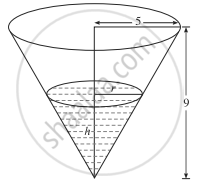
A right circular cone has height 9 cm and radius of the base 5 cm. It is inverted and water is poured into it. If at any instant the water level rises at the rate of `(pi/"A")`cm/sec, where A is the area of the water surface A at that instant, show that the vessel will be full in 75 seconds.

बेरीज
Advertisements

उत्तर

Let r be the radius of the water surface and h be the height of the water at time t.

∴ area of the water surface A = πr2 sq cm.

Since the height of the right circular cone is 9 cm and radius of the base is 5 cm.

`"r"/"h" = 5/9`    ∴ r = `5/9"h"`

∴ area of water surface, i.e. A = `pi(5/9 "h")^2`

∴ A = `(25 pi"h"^2)/81`      .....(1)

The water level, i.e. the rate of change of h is `"dh"/"dt"` rises at the rate of `(pi/"A")` cm/sec.

∴ `"dh"/"dt" = pi/"A" = (pi xx 81)/(25 pi "h"^2)`    ....[By (1)]

∴ `"dh"/"dt" = 81/(25 "h"^2)`

∴ `"h"^2 "dh" = 81/25 "dt"`

On integrating, we get

`int "h"^2 "dh" = 81/25 int "dt" + "c"`

∴ `"h"^3/3 = 81/25 * "t + c"`

Initially, i.e. when t = 0, h = 0

∴ 0 = 0 + c           ∴ c = 0

∴ `"h"^3/3 = 81/25 "t"`

When the vessel will be full, h = 9

∴ `(9)^3/3 = 81/25 xx "t"`

∴ t = `(81 xx 9 xx 25)/(3 xx 81) = 75`

Hence, the vessel will be full in 75 seconds.

shaalaa.com
Application of Differential Equations
  या प्रश्नात किंवा उत्तरात काही त्रुटी आहे का?
पाठ 6: Differential Equations - Exercise 6.6 [पृष्ठ २१३]

APPEARS IN

बालभारती Mathematics and Statistics 2 (Arts and Science) [English] Standard 12 Maharashtra State Board
पाठ 6 Differential Equations
Exercise 6.6 | Q 9 | पृष्ठ २१३

संबंधित प्रश्‍न

If the population of a country doubles in 60 years, in how many years will it be triple (treble) under the assumption that the rate of increase is proportional to the number of inhabitants?
(Given log 2 = 0.6912, log 3 = 1.0986)


If a body cools from 80°C to 50°C at room temperature of 25°C in 30 minutes, find the temperature of the body after 1 hour.


The rate of growth of bacteria is proportional to the number present. If initially, there were 1000 bacteria and the number doubles in 1 hour, find the number of bacteria after `2 1/2` hours.
[Take `sqrt2 = 1.414`]


The rate of decay of certain substances is directly proportional to the amount present at that instant. Initially, there is 25 gm of certain substance and two hours later it is found that 9 gm are left. Find the amount left after one more hour.


Find the population of a city at any time t, given that the rate of increase of population is proportional to the population at that instant and that in a period of 40 years, the population increased from 30,000 to 40,000.


A body cools according to Newton’s law from 100° C to 60° C in 20 minutes. The temperature of the surrounding being 20° C. How long will it take to cool down to 30° C?


Radium decomposes at the rate proportional to the amount present at any time. If p percent of the amount disappears in one year, what percent of the amount of radium will be left after 2 years?


Choose the correct option from the given alternatives:

The decay rate of certain substances is directly proportional to the amount present at that instant. Initially there are 27 grams of substance and 3 hours later it is found that 8 grams left. The amount left after one more hour is


Choose the correct option from the given alternatives:

If the surrounding air is kept at 20° C and a body cools from 80° C to 70° C in 5 minutes, the temperature of the body after 15 minutes will be


Show that the general solution of differential equation `"dy"/"dx" + ("y"^2 + "y" + 1)/("x"^2 + "x" + 1) = 0` is given by (x + y + 1) = (1 - x - y - 2xy).


The volume of a spherical balloon being inflated changes at a constant rate. If initially its radius is 3 units and after 3 seconds it is 6 units. Find the radius of the balloon after t seconds.


The rate of growth of population is proportional to the number present. If the population doubled in the last 25 years and the present population is 1 lac, when will the city have population 4,00,000?


If the population of a town increases at a rate proportional to the population at that time. If the population increases from 40 thousand to 60 thousand in 40 years, what will be the population in another 20 years? `("Given" sqrt(3/2) = 1.2247)`


Choose the correct alternative:

Bacterial increases at the rate proportional to the number present. If original number M doubles in 3 hours, then number of bacteria will be 4M in


Choose the correct alternative:

The integrating factor of `("d"^2y)/("d"x^2) - y` = ex, is e–x, then its solution is


Choose the correct alternative:

The solution of `("d"y)/("d"x) + x^2/y^2` = 0 is


The integrating factor of the differential equation `("d"y)/("d"x) - y` = x is ______


Integrating factor of `("d"y)/("d"x) + y/x` = x3 – 3 is ______


Find the population of city at any time t given that rate of increase of population is proportional to the population at that instant and that in a period of 40 years the population increased from 30000 to 40000.

Solution: Let p be the population at time t.

Then the rate of increase of p is `"dp"/"dt"` which is proportional to p.

∴ `"dp"/"dt" prop "p"`

∴ `"dp"/"dt"` = kp, where k is a constant.

∴ `"dp"/"p"` = k dt

On integrating, we get

`int "dp"/"p" = "k" int "dt"`

∴ log p = kt + c

Initially, i.e. when t = 0, let p = 30000

∴ log 30000 = k × 0 + c       

∴ c = `square`

∴ log p = kt + log 30000

∴ log p - log 30000 = kt

∴ `log("p"/30000)` = kt          .....(1)     

when t = 40, p = 40000

∴ `log (40000/30000) = 40"k"`

∴ k = `square`

∴ equation (1) becomes, `log ("p"/30000)` = `square`

∴ `log ("p"/30000) = "t"/40 log (4/3)`

∴ p = `square`


Bacteria increases at the rate proportional to the number of bacteria present. If the original number N doubles in 4 hours, find in how many hours the number of bacteria will be 16N.

Solution: Let x be the number of bacteria in the culture at time t.

Then the rate of increase of x is `("d"x)/"dt"` which is proportional to x.

∴ `("d"x)/"dt" ∝ x`

∴ `("d"x)/"dt"` = kx, where k is a constant

∴ `("d"x)/x` = kdt

On integrating, we get

`int ("d"x)/x = "k" int "dt"`

∴ log x = kt + c    .....(1)

∴ x = aekt where a = e

Initially, i.e.,when t = 0, let x = N

∴ N = aek(0)

∴ a = `square`

∴ a = N, x = Nekt    ......(2)

When t = 4, x = 2N

From equation (2), 2N = Ne4k

∴ e4k = 2

∴  e= `square`

Now we have to find out t, when x = 16N

From equation (2),

16N = Nekt 

∴ 16 = ekt 

∴ `"t"/4 = square` hours

Hence, number of bacteria will be 16N in `square` hours


The population of city doubles in 80 years, in how many years will it be triple when the rate of increase is proportional to the number of inhabitants. `("Given" log3/log2 = 1.5894)`

Solution: Let p be the population at time t.

Then the rate of increase of p is `"dp"/"dt"` which is proportional to p.

∴ `"dp"/"dt"  ∝  "p"`

∴ `"dp"/"dt"` = kp, where k is a constant

∴ `"dp"/"p"` = kdt

On integrating, we get

`int "dp"/"p" = "k" int "dt"`

∴ log p = kt + c

Initially, i.e., when t = 0, let p = N

∴ log N = k × 0 + c

∴ c = `square`

When t = 80, p = 2N

∴ log 2N = 80k + log N

∴ log 2N – log N = 80k

∴ `log ((2"N")/"N")` = 80k

∴ log (2) = 80k

∴ k = `square`

∴ p = 3N, then t = ?

∴ log p = `log2/80  "t" + log "N"`

∴ log 3N – log N = `square`

∴ t = `square` = `square` years


If the population grows at the rate of 8% per year, then the time taken for the population to be doubled, is (Given log 2 = 0.6912).


The rate of decay of certain substance is directly proportional to the amount present at that instant. Initially, there are 27 gm of certain substance and 3 h later it is found that 8 gm are left, then the amount left after one more hour is ______.


If the lengths of the transverse axis and the latus rectum of a hyperbola are 6 and `8/3` respectively, then the equation of the hyperbola is ______.


If r is the radius of spherical balloon at time t and the surface area of balloon changes at a constant rate K, then ______.


Let the population of rabbits surviving at a time t be governed by the differential equation `(dp(t))/dt = 1/2p(t) - 200`. If p(0) = 100, then p(t) equals ______ 


The length of the perimeter of a sector of a circle is 24 cm, the maximum area of the sector is ______.


If a curve y = f(x) passes through the point (1, - 1) and satisfies the differential equation, y (1 + xy) dx = x dy, then `f(-1/2)` is equal to ______ 


In a certain culture of bacteria, the rate of increase is proportional to the number present. If it is found that the number doubles in 4 hours, complete the following activity to find the number of times the bacteria are increased in 12 hours.


In a certain culture of bacteria, the rate of increase is proportional to the number present. If it is found that the number doubles in 4 hours, find the number of times the bacteria are increased in 12 hours.

Solution:

Let N be the number of bacteria present at time ‘t’.

Since the rate of increase of N is proportional to N, the differential equation can be written as –

`(dN)/dt αN`

∴ `(dN)/dt` = KN, where K is constant of proportionality

∴ `(dN)/N` = k . dt

∴ `int 1/N dN = K int 1 . dt`

∴ log N = `square` + C   ...(1)

When t = 0, N = N0 where N0 is initial number of bacteria.

∴ log N0 = K × 0 + C

∴ C = log N0

Also when t = 4, N = 2N0

∴ log (2 N0) = K . 4 + `square`   ...[From (1)]

∴ `log((2N_0)/N_0)` = 4K,

∴ log 2 = 4K

∴ K = `square`   ...(2)

Now N = ? when t = 12

From (1) and (2)

log N = `1/4 log 2  . (12) + log N_0`

log N – log N0 = 3 log 2

∴ `log(N_0/N_0)` = `square`

∴ N = 8 N0

∴ Bacteria are increased 8 times in 12 hours.


Bacteria increase at the rate proportional to the number of bacteria present. If the original number N doubles in 3 hours, find in how many hours the number of bacteria will be 4N?


The rate of growth of population is proportional to the number present. If the population doubled in the last 25 years and the present population is 1,00,000, when will the city have population 4,00,000?

Let ‘p’ be the population at time ‘t’ years.

∴ `("dp")/"dt" prop "p"`

∴ Differential equation can be written as  `("dp")/"dt" = "kp"`

where k is constant of proportionality.

∴ `("dp")/"p" = "k.dt"`

On integrating we get

`square` = kt + c   ...(i)

(i) Where t = 0, p = 1,00,000

∴ from (i)

log 1,00,000 = k(0) + c

∴  c = `square`

∴  log `("p"/(1,00,000)) = "kt"`       ...(ii)

(ii) When t = 25, p = 2,00,000

as population doubles in 25 years

∴ from (ii) log2 = 25k

∴  k = `square`

∴  log`("p"/(1,00,000)) = (1/25log2).t`

(iii) ∴ when p = 4,00,000

`log ((4,00,000)/(1,00,000)) = (1/25log2).t`

∴ `log 4 = (1/25 log2).t`

∴ t = `square ` years


Share
Notifications

Englishहिंदीमराठी


      Forgot password?
Use app×