Advertisements
Advertisements
प्रश्न
A line PQ is drawn parallel to the base BC of ∆ABC which meets sides AB and AC at points P and Q respectively. If AP = `1/3` PB; find the value of:
- $\dfrac{\text{Area of } \triangle ABC}{\text{Area of } \triangle APQ}$
- $\dfrac{\text{Area of } \triangle APQ}{\text{Area of trapezium } PBCQ}$
Advertisements
उत्तर
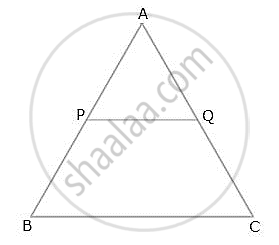
$AP = \dfrac{1}{3} PB \Rightarrow \dfrac{AP}{PB} = \dfrac{1}{3}$
i. In $\triangle APQ$ and $\triangle ABC$,
As $PQ \parallel BC$, corresponding angles are equal
$\angle APQ = \angle ABC$
$\angle AQP = \angle ACB$
$\triangle APQ \sim \triangle ABC$
$\dfrac{\text{Area of } \triangle ABC}{\text{Area of } \triangle APQ} = \dfrac{AB^2}{AP^2}$
$= \dfrac{4^2}{1^2} = 16 : 1$
$\left( \dfrac{AP}{PB} = \dfrac{1}{3} \Rightarrow \dfrac{AB}{AP} = \dfrac{4}{1} \right)$
ii. $\dfrac{\text{Area of } \triangle APQ}{\text{Area of trapezium } PBCQ}$
$= \dfrac{\text{Area of } \triangle APQ}{\text{Area of } \triangle ABC - \text{Area of } \triangle APQ}$
$= \dfrac{1}{16 - 1}$
$= \dfrac{1}{15}$
$= 1 : 15$
