Advertisements
Advertisements
प्रश्न
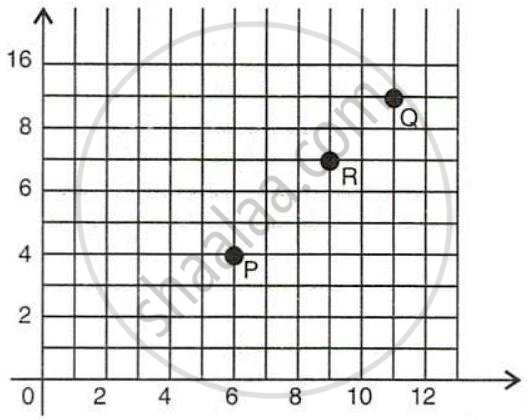
A group of class IX students goes to a picnic during winter holidays. The positions of three friends Nitin, Rajesh and Kareem are shown by the points P, Q and R respectively.
- Find the distance between:
- Nitin and Rajesh
- Rajesh and Kareem
- Nitin and Kareem
- Show that P, Q and R are collinear.
- Find the point on X-axis which is equidistant from points Q and R.
- If R is taken as origin; what will be the coordinates of P and Q?
Advertisements
उत्तर
(i) Distance Calculations
Using the Distance Formula: \[d = \sqrt{(x_2 - x_1)^2 + (y_2 - y_1)^2}\]
- Distance between Nitin P(3, 1) and Rajesh Q(6, 4): \[\text{PQ} = \sqrt{(6 - 3)^2 + (4 - 1)^2}\]
\[\text{PQ} = \sqrt{3^2 + 3^2} = \sqrt{9 + 9} = \sqrt{18} = 3\sqrt{2}\text{ units}\] - Distance between Rajesh Q(6, 4) and Kareem R(8, 6):
\[\text{QR} = \sqrt{(8 - 6)^2 + (6 - 4)^2}\]
\[\text{QR} = \sqrt{2^2 + 2^2} = \sqrt{4 + 4} = \sqrt{8} = 2\sqrt{2}\text{ units}\] - Distance between Nitin P(3, 1) and Kareem R(8, 6):
\[\text{PR} = \sqrt{(8 - 3)^2 + (6 - 1)^2}\]
\[\text{PR} = \sqrt{5^2 + 5^2} = \sqrt{25 + 25} = \sqrt{50} = 5\sqrt{2}\text{ units}\]
(ii) Collinearity of Points P, Q, and R
Three points are collinear if the sum of the lengths of two segments equals the length of the third segment. From part (i):
\[\text{PQ} + \text{QR} = 3\sqrt{2} + 2\sqrt{2} = 5\sqrt{2}\text{ units}\]
\[\text{PR} = 5\sqrt{2}\text{ units}\]
Since: PQ + QR = PR Therefore, points P, Q, and R lie on the same straight line and are collinear.
(iii) Point on X-axis Equidistant from Q and R
Let the required point on the x-axis be S(x, 0).
Given that S is equidistant from Q(6, 4) and R(8, 6):
\[\text{SQ} = \text{SR} \implies \text{SQ}^2 = \text{SR}^2\]
Applying the distance formula:
\[(x - 6)^2 + (0 - 4)^2 = (x - 8)^2 + (0 - 6)^2\]
\[x^2 - 12x + 36 + 16 = x^2 - 16x + 64 + 36\]
\[x^2 - 12x + 52 = x^2 - 16x + 100\]
Subtracting \(x^2\) from both sides:
\[-12x + 16x = 100 - 52\]
4x = 48
x = 12
Therefore, the required point on the x-axis is (12, 0).
(iv) Coordinates of P and Q when R is taken as Origin
If the origin is shifted to \[R(x_0, y_0) = (8, 6)\], the new coordinates (X, Y) of any point (x, y) are obtained by: \[X = x - x_0 = x - 8\] \[Y = y - y_0 = y - 6\]
- For point P(3, 1): \[X_P = 3 - 8 = -5\] \[Y_P = 1 - 6 = -5\] New coordinates of P: \((-5, -5)\)
- For point Q(6, 4): \[X_Q = 6 - 8 = -2\] \[Y_Q = 4 - 6 = -2\] New coordinates of Q: \((-2, -2)\)
