Advertisements
Advertisements
प्रश्न
A firm manufactures two products A and B on which profit earned per unit are ₹ 3 and ₹ 4 respectively. Each product is processed on two machines M1 and M2. The product A requires one minute of processing time on M1 and two minutes of processing time on M2, B requires one minute of processing time on M1 and one minute of processing time on M2. Machine M1 is available for use for 450 minutes while M2 is available for 600 minutes during any working day. Find the number of units of products A and B to be manufactured to get the maximum profit.
Advertisements
उत्तर
Let the firm manufacture x units of product A and y units of product B.
The profit earned per unit of A is ₹ 3 and B is ₹ 4.
Hence, the total profit is z = ₹ (3x + 4y)
This is the linear function that is to be maximized.
Hence, it is an objective function.
The constraints are as per the following table:
| Machine | Product A (x) |
Product B (y) |
Total availability of time (minutes) |
| M1 | 1 | 1 | 450 |
| M2 | 2 | 1 | 600 |
From the table, the constraints are x + y ≤ 450, 2x + y ≤ 600.
Since, the number of gift items cannot be negative, x ≥ 0, y ≥ 0.
∴ The mathematical formulation of LPP is,
Maximize z = 3x + 4y, subject to x + y ≤ 450, 2x + y ≤ 600, x ≥ 0, y ≥ 0.
Now, we draw the lines AB and CD, whose equations are x + y = 450 and 2x + y = 600, respectively.
| Line | Equation | Points on the X-axis |
Points on the Y-axis |
Sign | Region |
| AB | x + y = 450 | A(450, 0) | B(0, 450) | ≤ | origin side of line AB |
| CD | 2x + y = 600 | C(300, 0) | D(0, 600) | ≤ | origin side of line CD |
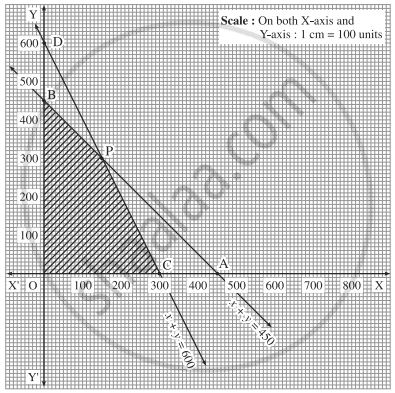
The feasible region is OCPBO which is shaded in the graph.
The vertices of the feasible region are O(0, 0), C(300, 0), P and B(0, 450).
P is the point of intersection of the lines
2x + y = 600 ...(1)
and x + y = 450 ...(2)
On subtracting, we get
∴ x = 150
Substituting x = 150 in equation (2), we get
150 + y = 450
∴ y = 300
∴ P ≡ (150, 300)
The values of the objective function z = 3x + 4y at these vertices are
z(O) = 3(0) + 4(0) = 0 + 0 = 0
z(C) = 3(300) + 4(0) = 900 + 0 = 900
z(P) = 3(150) + 4(300) = 450 + 1200 = 1650
z(B) = 3(0) + 4(450) = 0 + 1800 = 1800
∴ z has the maximum value of 1800 when x = 0 and y = 450.
Hence, the firm gets a maximum profit of ₹ 1800 if it manufactures 450 units of product B and no units of product A.
