Advertisements
Advertisements
प्रश्न
A current 0.2 A flows in a wire of resistance 15Ω. Find the potential difference across the ends of the wire.
Advertisements
उत्तर
I = 0.2 A
R = 15 V
According to Ohm's law ,
V = IR
∴ V = 0.2 × 15 = 3.0 V
APPEARS IN
संबंधित प्रश्न
What is a primary cell?
State three differences between the primary and secondary cells.
How is the current flowing in a conductor changed if the resistance of conductor is doubled keeping the potential difference across it the same?
There is a positively charged sphere A and negatively charged sphere B, such that they are brought in electrical contact by a copper wire.
In which direction conventional current flows?
State SI unit of electric charge and define it.
Select the correct option:
In a metallic conductor, electric current is thought to be due to movement of:
Assuming that the charges of an electron is 1.6 × 10⁻¹⁹ coulombs, the number of electrons passing through a section of wire per sec, when the wire carries a current of one ampere is:
The following figure shows a metal rod PQ mounted on an insulated stand. The cap of an uncharged electroscope touches one end Q of the metal rod. A negatively charged ebonite rod is brought near the other end P of the metal rod.
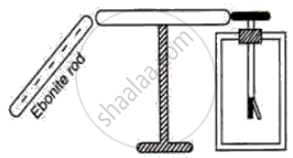
(a) What charge does the end P have?
(b) What charge does the end Q have?
(c) What charge does the cap of the electroscope have?
(d) What charge does the gold leaf have?
(e) Will the leaf diverge or collapse? Give reason.
(f) If the electroscope is now earthed, what charge does the metal rod have?
What is the physical meaning of resistance?
