Advertisements
Advertisements
प्रश्न
A cricket fielder can throw the cricket ball with a speed vo. If he throws the ball while running with speed u at an angle θ to the horizontal, find
- the effective angle to the horizontal at which the ball is projected in air as seen by a spectator.
- what will be time of flight?
- what is the distance (horizontal range) from the point of projection at which the ball will land?
- find θ at which he should throw the ball that would maximise the horizontal range as found in (iii).
- how does θ for maximum range change if u > vo, u = vo, u < vo?
- how does θ in (v) compare with that for u = 0 (i.e.45)?
Advertisements
उत्तर
Consider the adjacent diagram,
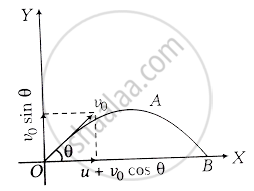
a. Initial velocity in x-direction, `u_x = u + v_0 cos theta`
`u_y` = Initial velocity in y-direction
= `v_0 sin theta`
Where the angle of projection is θ.
Now, we can write
`tan theta = u_y/U_x = (u_0 sin theta)/(u + u_0 cos theta)`
⇒ `θ = tan^-1 ((v_0 sin theta)/(u + v_0 cos theta))`
b. Let T be the time of the flight.
As net displacement is zero over time period T.
`y = 0, u_y = v_0 sin θ, a-y = - g, t = T`
We know that `y = u_yt + 1/2 a_yt^2`
⇒ 0 = `v_0 sin θ T + 1/2 (- g) T^2`
⇒ `T[v_0 sin θ - g/2 T]` = 0
⇒ T = `0, (2v_g sin θ)/g`
T = 01, which corresponds to point O.
Hence, T = `(2u_0 sin θ)/g`
c. Horizontal range, `R(u + v_0 cos θ)`
`T = (u + v_0 cos θ) (2v_0 sin θ)/g`
= `v_0/g [2u sin θ + v_0 sin 2θ]`
d. For horizontal range to be maximum , `(dR)/(dθ)` = 0
⇒ `v_0/g [2u cos θ + v_0 cos 2θ xx 2]` = 0
⇒ `2u cos θ + 2v_0 [2cos^2θ - 1]` = 0
⇒ `4v_0 cos^2θ + 2u cos θ - 2v_0` = 0
⇒ `2v_0 cos^2θ + u cos θ - v_0` = 0
⇒ `cos θ = (-u +- sqrt(u^2 + 8v_0^2))/(4v_0)`
⇒ `θ_"max" cos^-1 [(-u +- sqrt(u^2 + 8v_0^2))/(4v_0)]`
= `cos^-1 [(-u + sqrt(u^2 + 8v_0^2))/(4v_0)]`
e. If u = v0,
`cos θ = (-v_0 +- sqrt(v_0^2 + 8v_0^2))/(4v_0) = (-1 + 3)/4 = 1/2`
If `u < < v_0`, then `8v_0^2 + u^2 ≈ 8v_0^2`
`θ_"max" = cos^-1[(-u +- 2sqrt(2)v_0)/(4v_0)] = cos^-1[1/sqrt(2) - u/(4v_0)]`
If `u < < v_0`, then `θ_"max" = cos^-1 (1/sqrt(2)) = π/4`
If `u > u_0` and `u > > v_0`
`θ_"max" = cos^-1 [(-u +- u)/(4v_0)]` = 0
⇒ `θ_"max" = π/2`
f. If u = 0, `θ_"max" = cos^-1 [(0 +- sqrt(8v_0^2))/(4v_0)]`
= `cos^-1 (1/sqrt(2))`
= 45°
