Advertisements
Advertisements
प्रश्न
A company manufactures two types of products A and B. Each unit of A requires 3 grams of nickel and 1 gram of chromium, while each unit of B requires 1 gram of nickel and 2 grams of chromium. The firm can produce 9 grams of nickel and 8 grams of chromium. The profit is ₹ 40 on each unit of the product of type A and ₹ 50 on each unit of type B. How many units of each type should the company manufacture so as to earn a maximum profit? Use linear programming to find the solution.
Advertisements
उत्तर
Let x units of type A and y units of type B be produced.
Now, max Z = 40x + 50y
sub to 3x + y ≤ 9
x + 2y ≤ 8
x, y ≥ 0
Point of intersection is given by :
6x + 2y = 18
x + 2y = 8
`((-) (-) (-))/(5x = 10)`
x = 2
y = `(8 - 2)/(2) = 3`
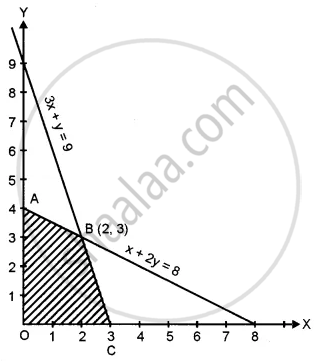
Coordinates of O is (0, 0)
Coordinates of A is (0, 4)
Coordinates of C is (3, 0)
Coordinates of B is (2, 3)
At O, Z = 0
At A, Z = 40 × 0 + 50 × 4 = ₹ 200
At B, Z = 40 × 2 + 50 × 3 = 80 + 150 = ₹ 230
At C, Z = 40 × 3 + 50 × 0 = ₹ 120
The feasible region is the shaded portion.
Maximum profit is ₹ 230 at B (2, 3) i.e., the company produces 2 units of type A product and 3 units of type B product.
