Advertisements
Advertisements
प्रश्न
A circle with centre P is inscribed in the ∆ABC. Side AB, side BC, and side AC touch the circle at points L, M, and N respectively. The radius of the circle is r.
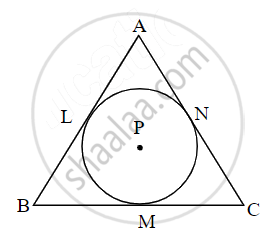
Prove that: A(ΔABC) = `1/2` (AB + BC + AC) × r
Advertisements
उत्तर
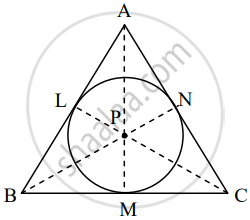
Given: Side AB, side BC, and side AC are tangents to circle at L, M, and N respectively. Radius = r
To prove: A(∆ABC) = `1/2` (AB + BC + AC) × r
Construction: Join seg PM, seg PN, seg PL, seg AP, seg BP and seg CP.
Proof: seg BC is a tangent to circle at M.
∴ seg PL ⊥ side AB
seg PM ⊥ side BC
seg PN ⊥ side AC (By the theorem, the tangent is perpendicular to the radius)
We know,
Area of triangle = `1/2 xx "base" xx "height"`
∴ seg PM ⊥ seg BC ......[Tangent is perpendicular to radius]
A(∆BPC) = `1/2` × BC × PM
∴ A (∆BPC) = `1/2` × BC × r ......(i) [PM = radius = r]
Similarly,
A(∆APB) = `1/2` × AB × "r" ......(ii)
A(∆APC) = `1/2` × AC × "r" ......(iii)
Now,
A(∆ABC) = A(∆APB) + A(∆BPC) + A(∆APC) ......[Area addition property]
= `1/2 xx "AB" xx "r" + 1/2 xx "BC" xx "r" + 1/2 xx "AC" xx "r"` .......[From (i), (ii), and (iii)]
= `1/2 xx "r" ("AB + BC + AC")`
∴ A(∆ABC) = `1/2 ("AB + BC + AC") xx "r"`
