Advertisements
Advertisements
प्रश्न
A body of mass m falls from a height h1 to a height h2, above the ground (h1 > h2). What is the loss of potential energy?
Advertisements
उत्तर
At height h1, initial potential energy of body = mgh1
At height h2, final potential energy of body = mgh2
Loss in potential energy = Initial potential energy − Final potential energy
= (mgh1 − mgh2)
= mg (h1 − h2)
संबंधित प्रश्न
Explain how, geothermal energy is used to generate electricity.
Name the type of energy (kinetic or potential) possessed by the following:
A compressed spring.
A ball is made to fall freely from a height. State the kind/ kinds of energy possessed by the ball when it is just in the middle .
What is meant by the renewable and non-renewable sources of energy? Distinguish between them giving two examples of weach.
State two advantages of using wind energy for generating electricity.
Write the type of energy possessed in the following case:
A wound-up spring
State the energy changes which take place when:
Food is digested by animals.
A body of mass m is taken from a height h to 2h. What is the increase in its potential energy?
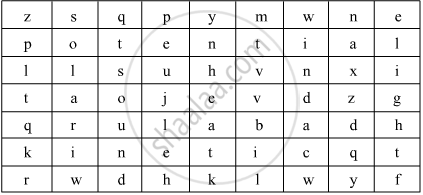
Find out the types of energy from the following puzzle.
What are the small particles that can be seen in a beam of light that enters a dark room?
