Advertisements
Advertisements
प्रश्न
A body of mass m falls down through a height h. Obtain an expression for the work done by the force of gravity.
Advertisements
उत्तर
Assume that a body A with mass'm' is elevated 'h' above the ground, and B falls.
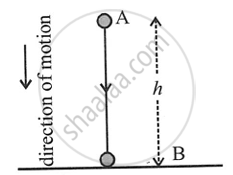
Force acting on 'm' at A is mg force of gravity.
Displacement = height = h
Work done in falling W = force × displacement
W = mg × h
The formula for the amount of work that gravity has done is W = mgh.
APPEARS IN
संबंधित प्रश्न
What is the source of heat contained in geothermal energy?
What do you understand by the kinetic energy of a body?
Why using wood as fuel is not advisable although wood is a renewable source of energy?
Name five renewable sources of energy.
How much electric power is generated in India using the wing energy?
What is nuclear energy?
Is it possible that a body may possess energy even when it is not in motion?
Write the type of energy possessed in the following case:
A bent bow
Give one example when:
Heat energy changes to kinetic energy.
Calculate the change in the Kinetic energy of a moving body if its velocity is reduced to 1/3rd of the initial velocity.
