Advertisements
Advertisements
प्रश्न
A body cools from 80 °C to 50 °C in 5 minutes. Calculate the time it takes to cool from 60 °C to 30 °C. The temperature of the surroundings is 20 °C.
Advertisements
उत्तर १
According to Newton’s law of cooling, we have:
`- (dT)/(dt) = K(T - T_0)`
`(dT)/(K(T-T_0)) = -kdt` ...(i)
Where,
Temperature of the body = T
Temperature of the surroundings = T0 = 20°C
K is a constant
Temperature of the body falls from 80°C to 50°C in time, t = 5 min = 300 s
Integrating equation (i), we get:
`int_50^80 (dt)/(K(T - T_0)) = -int_0^300Kdt`
`[log_e(T-T_0)]_50^80 = -K[t]_0^300`
`2.3026/K log_10 (80-20)/(50-20) = -300`
`2.3026/K =log_10 2 = -300` ....(ii)
The temperature of the body falls from 60°C to 30°C in time = t’
Hence, we get:
`2.3026/K log_10 (60-20)/(30-20) = -t`
`-2.3026/t log_10 4 = K` ...(iii)
Equating equations (ii) and (iii), we get:
`-2.3026/t log_10 4 = (-2.3026)/300 log_10 2`
:.t = 300 x 2 = 600 s = 10 min
Therefore, the time taken to cool the body from 60°C to 30°C is 10 minutes.
उत्तर २
According to Newton's law of cooling, the rate of cooling is proportional to the difference in temperature.`
Here Average of `80 ^@C` and `50 ^@C = 65 ^@C`
Temperature of surroundings = `20^@C`
:. Difference = `65 - 20 = 45 ^@C`
Under these condition. the body cools `30^@C` in time 5 minutes
`:. "Change in temp"/"Time" = K triangleT` or `30/5 = K xx 45^@` .. (1)
The average of `60^@C` and `30^@` is `45^@C` which is `25^@C`(45 - 20) above the room temperature anf the bodycppls by `30^@C`(60 - 30) in time t (say)
`:. 30/t = K xx 25` ...(ii)
Where K is same for this situation as for the original.
Dividing equation i by ii we get
`="30/5"/"30/t" = (Kxx45)/(Kxx25)`
or `t/5 = 9/5`
`=> t = 9 min`
APPEARS IN
संबंधित प्रश्न
The temperature of the atmosphere at a high altitude is around 500°C. Yet an animal there would freeze to death and not boil. Explain.
Newton's law of cooling is a special case of
Answer the following question.
State Newton’s law of cooling and explain how it can be experimentally verified.
Solve the following problem.
A metal sphere cools at the rate of 0.05 ºC/s when its temperature is 70 ºC and at the rate of 0.025 ºC/s when its temperature is 50 ºC. Determine the temperature of the surroundings and find the rate of cooling when the temperature of the metal sphere is 40 ºC.
A metal sphere cools from 80 °C to 60 °C in 6 min. How much time with it take to cool from 60 °C to 40 °C if the room temperature is 30 °C?
A bucket full of hot water cools from 85 °C to 80 °C in time T1, from 80 °C to 75 °C in time T2 and from 75 °C to 70 °C in time T3, then ______.
Rate of cooling of a body is 0.4 °C/min when excess temperature is 20 °C. The proportionality constant is ______.
Two circular discs A and B with equal radii are blackened. They are heated to the same temperature and are cooled under identical conditions. What inference do you draw from their cooling curves?
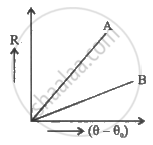
A cup of coffee cools from 90°C to 80°C in t minutes, when the room temperature is 20°C. The time taken for a similar cup of coffee to cool from 80°C to 60°C at a room temperature same at 20°C is ______
A cup of coffee cools from 90°C to 80°C in t minutes, when the room temperature is 20°C. The time taken by a similar cup of coffee to cool from 80°C to 60°C at a room temperature same at 20°C is ______.
According to Newton's law of cooling, how does the rate of cooling depend on temperature?
What is the shape of the cooling curve T vs t?
If we plot \[\frac{dT}{dt}\] vs (T−T₀), what graph do we get?
Why must the surrounding temperature T₀ remain constant in the experiment?
A body is cooling from 80°C to 60°C in a room at 30°C. Compared to the time taken to cool from 60°C to 40°C, the time taken to cool from 80°C to 60°C will be ______.
