Advertisements
Advertisements
प्रश्न
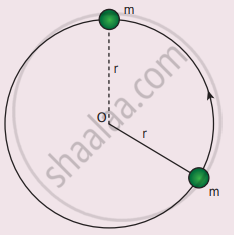
A bob of mass m is attached to one end of the rod of negligible mass and length r, the other end of which is pivoted freely at a fixed center O as shown in the figure. What initial speed must be given to the object to reach the top of the circle? (Hint: Use law of conservation of energy). Is this speed less or greater than the speed obtained in section 4.2.9?
Advertisements
उत्तर
To get the vertical speed given to the object to reach the top of the circle, the law of conservation of energy can be used at points (1) and (2)
Total energy at 1 = Total energy at 2
∴ Potential energy at point 1 = 0


from eqn (i)
`0 + 1/2mv_1^2 = 2mgr + 1/2mv_2^2`
= `1/2v_1^2 = 2gr + 1/2v_2^2`
= `v_1^2 - v_2^2 = 4gr` ...........................(2)
In this case, the bob of mass m is connected with a rod of negligible mass, so the velocity of the bob at the highest point can be equal to zero i.e. v2 = 0
∴ eqn. (2) becomes `v_1^2 = 4gr, v_1 = sqrt(4gr) ms^-1 "or" v_1 = 2sqrt(gr) ms^-1`
The speed of the bob obtained here is lesser than the speed obtained in section 4.2.9. It is only because the string is replaced by a massless rod here.
APPEARS IN
संबंधित प्रश्न
What is the significance of energy? Differentiate between commercial and non-commercial sources of energy.
How are the rates of consumption of energy and economic growth connected?
What problems are being faced by the power sector in India?
An engine pumps water continuously through a hose. Water leaves the hose with a velocity v and m is the mass per unit length of the water of the jet. What is the rate at which kinetic energy is imparted to water?.
The potential energy of a system increases, if work is done ______
Write the various types of potential energy. Explain the formulae.
Which of the following is a commercial source of energy?
Which of the following indicates that the rate of consumption of energy and economic growth are connected?
______ with the healing power of nature as it assumes that all healing powers are within our body.
The ______ is usually instituted via law and is typically applied to necessary goods like food, rent, and energy sources in order to ensure that everyone has access to them.
