Advertisements
Advertisements
प्रश्न
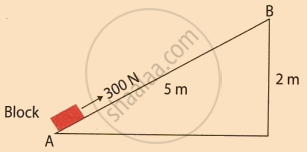
A block of mass 40 kg is pulled up a slope with a constant speed by applying a force of 300 N parallel to the slope as shown in the figure. A and B are initial and final positions of the block, respectively.
- Calculate the work done by force in moving the block from position A to position B.
- Calculate the potential gained by the block.
(Consider g = 10 m/s2.)
Advertisements
उत्तर
Given Data:
Mass of the block (m) = 40 kg
Applied force parallel to the slope (F) = 300 N
Distance moved along the slope (s) = 5 m
Vertical height gained (h) = 2 m
Acceleration due to gravity (g) = 10 m/s2
(i) Work done (W) is the product of the force and the displacement in the direction of the force. Here, the force is applied parallel to the slope, so we use the distance along the slope (s = 5 m).
W = F × s
= 300 N × 5 m
= 1500 J
(ii) Potential energy gained (PE) depends strictly on the vertical height raised, regardless of the path taken.
PE = m × g × h
= 40 kg × 10 m/s2 × 2 m
= 800 J
