Advertisements
Advertisements
प्रश्न
A 2.0 cm tall object is placed 40 cm from a diverging lens of focal length 15 cm. Find the position and size of the image.
Advertisements
उत्तर
A concave lens is also known as a diverging lens.
Focal length of concave lens, f = -15 cm
Object distance from the lens, u = -40 cm
Height of the object, h1 = 2.0 cm
Height of the image, h2 = ?
Using the lens formula, we get:
`1/f=1/v-1/u`
`1/-15=1/v-1/-40`
`1/-15=1/v+1/40`
`1/v=1/-15-1/40`
`1/v=(-8-3)/120`
`1/v=-11/120`
∴ v = - 10.90 cm
Therefore, the image is formed at a distance of 10.90 cm and to the left of the lens.
Magnification of the lens:
Magnification=`"Image distance"/"object distance"="Height of the image"/"Height of the object"`
`v/u=h_2/h_1`
`-10.90/-40=h_2/2`
h_2=+0.54
The height of the image formed is 0.54 cm. Also, the positive sign of the height of the image shows that the image is erect.
APPEARS IN
संबंधित प्रश्न
A simple microscope is used by watch repairers. Give reason.
One half of a convex lens of focal length 10 cm is covered with a black paper. Can such a lens produce an image of a complete object placed at a distance of 30 cm from the lens? Draw a ray diagram to justify your answer. A 4 cm tall object is placed perpendicular to its principal axis of a convex lens of focal length 20 cm. The distance of the object from the lens is 15 cm. Find the nature, position and the size of the image.
An image that cannot be obtained on a screen is called ______.
The letter F is placed in front of a plane mirror:
What is the name of the phenomenon involved?
What is a spherical mirror?
What do you understand by the focus and focal length of a spherical mirror? Show them on the separate diagrams for each of a concave mirror and a convex mirror.
State the types of mirrors used for (i) headlights and (ii) rear view mirror, in cars and motorcycles. Give to justify your answer in each case.
Explain the following term:
Incident ray
Draw diagram/diagrams to show them.
Name the spherical mirror which (i) diverges (ii) converges the beam of light incident on it. Justify your answer by drawing a ray diagram in each case.
What is meant by magnification? Write its expression. What is its sign for the (a) real (b) virtual, image?
The focal length of a concave mirror is 10 cm. Find its radius of curvature.
Define the following term:
concave mirror
What is a mirror formula?
What is the relationship between the focal length and radius of curvature?
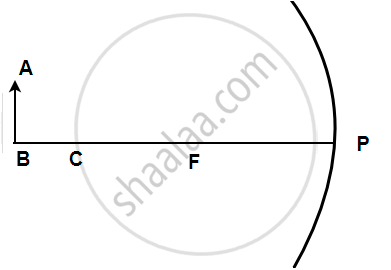
The following figure shows a concave mirror with its pole (P), focus (F), and center of curvature (C). Draw a ray diagram to show the formation of the image of an object AB by the concave mirror.
Define the term Principle focus.
Explain why a ray of light passing through the center of curvature of a concave mirror, gets reflected along with the same pattern.
How tall does a mirror have to be to fit an entire person’s body?
