Advertisements
Advertisements
प्रश्न
A 1000 kg vehicle moving with a speed of 20 m/s is brought to rest in a distance of 50 metres :
(i) Find the acceleration.
(ii) Calculate the unbalanced force acting on the vehicle.
Advertisements
उत्तर
(i) Final velocity, v = 0 (because the car is brought to rest)
Distance covered, s = 50 m
So, Force = mass × acceleration
But we do not know the value of a.
Making use of the third equation of motion we get,
v2 − u2 = 2as
⇒ 0 − 202 = 2 × a × 50
⇒ −400 = 100a
⇒ a = −4
The acceleration = −4 m/s2
(ii) Force = mass × acceleration
Mass = 1000 kg
Force = 1000 × (−4)
= − 4000 N
Unbalanced force acting on the vehicle is −4000 N.
APPEARS IN
संबंधित प्रश्न
Fill in the following blank with suitable word:
When a running car stops suddenly, the passengers are jerked …………………..
Give reason for the following :
When a hanging carpet is beaten with a stick, the dust particles start coming out of it.
Give one example where a force stops a moving body.
Give one example where a force changes the direction of a moving body.
Give one example where a force changes the shape (and size) of a body.
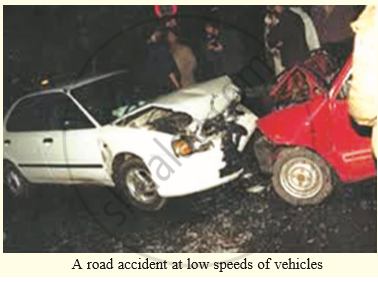
Why are road accidents at high speeds very much worse than road accidents at low speeds ?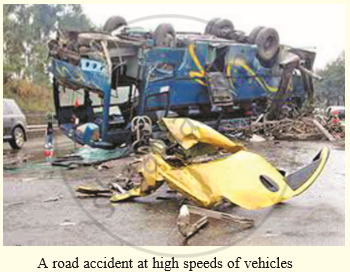
A car is moving on a level road. If the driver turns off the engine of the car, the car’s speed decreases gradually and ultimately it comes to a stop. A student says that two forces act on the car which bring it to a stop. What could these forces be ? Which of these two forces contributes more to slow down and stop the car ?
There are two types of forces X and Y. The forces belonging to type X can produce motion in a stationary object but cannot change the shape of the object. On the other hand, forces belonging to type Y cannot produce motion in a stationary object but can change the object. What is the general name of the forces as (a) X, and (b) Y?
When we talk of a force acting on a body, it usually means :
Why does it happen?
If a stationary bus suddenly speeds up, passengers are thrown in the backward direction.
