Please select a subject first
Advertisements
Advertisements
p(x) is a polynomial of degree 1 and q(x) is a polynomial of degree 2. What kind of the polynomial is p(x) × q(x)?
Concept: undefined >> undefined
Degree of the polynomial (y3 – 2)(y3 + 1) is
Concept: undefined >> undefined
Advertisements
Degree of the constant polynomial is __________
Concept: undefined >> undefined
Find the Total Surface Area and the Lateral Surface Area of a cuboid whose dimensions are: length = 20 cm, breadth = 15 cm, height = 8 cm
Concept: undefined >> undefined
The dimensions of a cuboidal box are 6 m × 400 cm × 1.5 m. Find the cost of painting its entire outer surface at the rate of ₹ 22 per m2.
Concept: undefined >> undefined
The dimensions of a hall is 10 m × 9 m × 8 m. Find the cost of white washing the walls and ceiling at the rate of ₹ 8.50 per m2
Concept: undefined >> undefined
Three identical cubes of side 4 cm are joined end to end. Find the total surface area and lateral surface area of the new resulting cuboid
Concept: undefined >> undefined
The total surface area of a cuboid with dimension 10 cm × 6 cm × 5 cm is
Concept: undefined >> undefined
Using the adjacent Venn diagram, find the following set:
A – B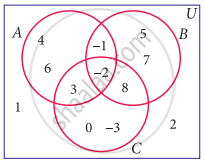
Concept: undefined >> undefined
Using the adjacent Venn diagram, find the following set:
B – C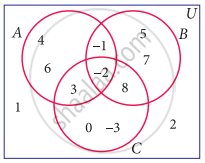
Concept: undefined >> undefined
Using the adjacent Venn diagram, find the following set:
A’ ∪ B’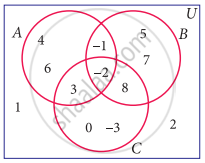
Concept: undefined >> undefined
Using the adjacent Venn diagram, find the following set:
A’ ∩ B’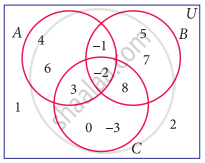
Concept: undefined >> undefined
Using the adjacent Venn diagram, find the following set:
(B ∪ C)’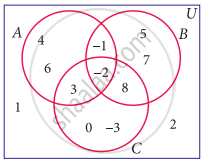
Concept: undefined >> undefined
Using the adjacent Venn diagram, find the following set:
A – (B ∪ C)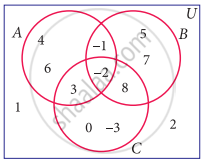
Concept: undefined >> undefined
Using the adjacent Venn diagram, find the following set:
A – (B ∩ C)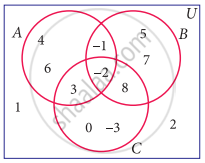
Concept: undefined >> undefined
If K = {a, b, d, e, f}, L = {b, c, d, g} and M = {a, b, c, d, h} then find the following:
K ∪ (L ∩ M)
Concept: undefined >> undefined
If K = {a, b, d, e, f}, L = {b, c, d, g} and M = {a, b, c, d, h} then find the following:
K ∩ (L ∪ M)
Concept: undefined >> undefined
If K = {a, b, d, e, f}, L = {b, c, d, g} and M = {a, b, c, d, h} then find the following:
(K ∪ L) ∩ (K ∪ M)
Concept: undefined >> undefined
If K = {a, b, d, e, f}, L = {b, c, d, g} and M = {a, b, c, d, h} then find the following:
(K ∩ L) ∪ (K ∩ M) and verify distributive laws
Concept: undefined >> undefined
If A = {x : x ∈ Z, −2 < x ≤ 4}, B = {x : x ∈ W, x ≤ 5}, C = {− 4, −1, 0, 2, 3, 4} verify A ∪ (B ∩ C) = (A ∪ B) ∩ (A ∪ C)
Concept: undefined >> undefined
