Advertisements
Advertisements
The figure shows the V-T diagram for one cycle of a hypothetical heat engine which uses the ideal gas. Draw the p-V diagram diagram of the system.
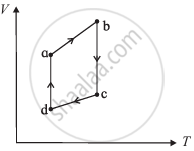
Concept: undefined >> undefined
Draw graphs of displacement, velocity, and acceleration against phase angle, for a particle performing linear S.H.M. from
- the mean position
- the positive extreme position.
Deduce your conclusions from the graph.
Concept: undefined >> undefined
Advertisements
Two sound waves travel at a speed of 330 m/s. If their frequencies are also identical and are equal to 540 Hz, what will be the phase difference between the waves at points 3.5 m from one source and 3 m from the other if the sources are in phase?
Concept: undefined >> undefined
A set of 8 tuning forks is arranged in a series of increasing order of frequencies. Each fork gives 4 beats per second with the next one and the frequency of last fork is twice that of the first. Calculate the frequencies of the first and the last fork.
Concept: undefined >> undefined
Answer in brief:
If a copper disc swings between the poles of a magnet, the pendulum comes to rest very quickly. Explain the reason. What happens to the mechanical energy of the pendulum?
Concept: undefined >> undefined
The angular momentum of a system of particles is conserved ______
Concept: undefined >> undefined
Obtain an expression for the angular momentum of a body rotating with uniform angular velocity.
Concept: undefined >> undefined
Show the graphical representation of radiant power of a black body per unit range of wavelength as a function of wavelength.
Concept: undefined >> undefined
Draw a neat labeled diagram of Ferry’s black body.
Concept: undefined >> undefined
Explain the construction and working of Ferry’s black body.
Concept: undefined >> undefined
Compare the rates of emission of heat by a blackbody maintained at 627°C and at 127°C, if the black bodies are surrounded by an enclosure at 27°C. What would be the ratio of their rates of loss of heat?
Concept: undefined >> undefined
State any four applications of beats.
Concept: undefined >> undefined
Explain the production of beats and deduce analytically the expression for beats frequency.
Concept: undefined >> undefined
State the conditions when the magnetic potential energy of a magnetic dipole (current-carrying coil) kept in the uniform magnetic field be minimum and maximum.
Concept: undefined >> undefined
The role of inductance is equivalent to ______
Concept: undefined >> undefined
A plane of a coil of 10 turns is tightly wound around a solenoid of diameter 2 cm having 400 turns per centimeter. The relative permeability of the core is 800. Calculate the inductance of the solenoid.
Concept: undefined >> undefined
Prove that the frequency of beats is equal to the difference between the frequencies of the two sound notes giving rise to beats.
Concept: undefined >> undefined
What is the average value of alternating current over a complete cycle?
Concept: undefined >> undefined
Two tuning forks of frequencies 320 Hz and 340 Hz are sounded together to produce a sound wave. The velocity of sound in air is 326.4 m/s. Calculate the difference in wavelengths of these waves.
Concept: undefined >> undefined
