Advertisements
Advertisements
A uniform rod is kept vertically on a horizontal smooth surface at a point O. If it is rotated slightly and released, it falls down on the horizontal surface. The lower end will remain _________ .
Concept: undefined >> undefined
A uniform chain of mass M and length L is held vertically in such a way that its lower end just touches the horizontal floor. The chain is released from rest in this position. Any portion that strikes the floor comes to test. Assuming that the chain does not form a heap on the floor calculate the force exerted by it on the floor when a length x has reached the floor.
Concept: undefined >> undefined
Advertisements
A rod of mass m and length L, lying horizontally, is free to rotate about a vertical axis through its centre. A horizontal force of constant magnitude F acts on the rod at a distance of L/4 from the centre. The force is always perpendicular to the rod. Find the angle rotated by the rod during the time t after the motion starts.
Concept: undefined >> undefined
A square plate of mass 120 g and edge 5⋅0 cm rotates about one of the edges. If it has a uniform angular acceleration of 0⋅2 rad/s2 what torque acts on the plate?
Concept: undefined >> undefined
Calculate the torque on the square plate of the previous problem if it rotates about a diagonal with the same angular acceleration.
Concept: undefined >> undefined
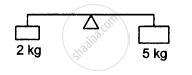
A light rod of length 1 m is pivoted at its centre and two masses of 5 kg and 2 kg are hung from the ends as shown in the following figure. Find the initial angular acceleration of the rod assuming that it was horizontal in the beginning.
Concept: undefined >> undefined
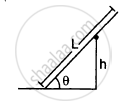
A uniform rod of length L rests against a smooth roller as shown in the following figure. Find the friction coefficient between the ground and the lower end if the minimum angle that the rod can make the horizontal is θ.
Concept: undefined >> undefined
A uniform rod of mass 300 g and length 50 cm rotates at a uniform angular speed of 2 rad/s about an axis perpendicular to the rod through an end. Calculate (a) the angular momentum of the rod about the axis of rotation, (b) the speed of the centre of the rod and (c) its kinetic energy.
Concept: undefined >> undefined
A uniform rod of length L lies on a smooth horizontal table. A particle moving on the table strikes the rod perpendicularly at an end and stops. Find the distance travelled by the centre of the rod by the time it turns through a right angle. Show that if the mass of the rod is four times that of the particle, the collision is elastic.
Concept: undefined >> undefined
A solid object is placed in water contained in an adiabatic container for some time. The temperature of water falls during this period and there is no appreciable change in the shape of the object. The temperature of the solid object
Concept: undefined >> undefined
A bullet of mass 20 g enters into a fixed wooden block with a speed of 40 m s−1 and stops in it. Find the change in internal energy during the process.
Concept: undefined >> undefined
A brick weighing 4.0 kg is dropped into a 1.0 m deep river from a height of 2.0 m. Assuming that 80% of the gravitational potential energy is finally converted into thermal energy, find this thermal energy is calorie.
Concept: undefined >> undefined
A van of mass 1500 kg travelling at a speed of 54 km h−1 is stopped in 10 s. Assuming that all the mechanical energy lost appears as thermal energy in the brake mechanism, find the average rate of production of thermal energy is cal s−1.
Concept: undefined >> undefined
A block of mass 100 g slides on a rough horizontal surface. If the speed of the block decreases from 10 m s−1 to 5 m s−1, find the thermal energy developed in the process.
Concept: undefined >> undefined
The blocks of masses 10 kg and 20 kg moving at speeds of 10 m s−1 and 20 m s−1respectively in opposite directions, approach each other and collide. If the collision is completely inelastic, find the thermal energy developed in the process.
Concept: undefined >> undefined
The thermal conductivity of a rod depends on
Concept: undefined >> undefined
One end of a metal rod is kept in a furnace. In steady state, the temperature of the rod
Concept: undefined >> undefined
A hot liquid is kept in a big room. The logarithm of the numerical value of the temperature difference between the liquid and the room is plotted against time. The plot will be very nearly
Concept: undefined >> undefined
A piece of charcoal and a piece of shining steel of the same surface area are kept for a long time in an open lawn in bright sun.
(a) The steel will absorb more heat than the charcoal
(b) The temperature of the steel will be higher than that of the charcoal
(c) If both are picked up by bare hand, the steel will be felt hotter than the charcoal
(d) If the two are picked up from the lawn and kept in a cold chamber, the charcoal will lose heat at a faster rate than the steel.
Concept: undefined >> undefined
A uniform slab of dimension 10 cm × 10 cm × 1 cm is kept between two heat reservoirs at temperatures 10°C and 90°C. The larger surface areas touch the reservoirs. The thermal conductivity of the material is 0.80 W m−1 °C−1. Find the amount of heat flowing through the slab per minute.
Concept: undefined >> undefined
