Advertisements
Advertisements
Force acting on a particle is (2`hat"i"` + 3 `hat"j"`) N. Work done by this force is zero, when a particle is moved on the line 3y + kx = 5. Here value of k is ______.
Concept: undefined >> undefined
A body is displaced from (0, 0) to (1 m, 1 m) along the path x = y by a force F = (x2`hat"J"` + y`hat"i"`)N. The work done by this force will be:
Concept: undefined >> undefined
Advertisements
If energy (E), velocity (V) and force (F), be taken as fundamental quantities, then what are the dimensions of mass?
Concept: undefined >> undefined
If the units of length and force are increased four times, then the unit of energy will ______.
Concept: undefined >> undefined
A body moving with uniform acceleration describes 4 m in the third second and 12 m in the fifth second. The distance described in the next three seconds is ______.
Concept: undefined >> undefined
The r.m.s. speed of a certain gas is v at 127°C K. The temperature at which the r.m.s. speed becomes two times, will be ______.
Concept: undefined >> undefined
Two blocks P and Q of masses 0.3 kg and 0.4 kg, respectively, are stuck to each other by some weak glue as shown in the figure. They hang together at the end of a spring with a spring constant of k = 200 N/m. The block Q suddenly falls free due to the failure of glue, then the maximum kinetic energy of block P during subsequent motion will be ______ mJ.
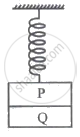
Concept: undefined >> undefined
An object of mass 0.5 kg is executing a simple Harmonic motion. Its amplitude is 5 cm and the time period (T) is 0.2 s. What will be the potential energy of the object at an instant t = `T/4` s starting from the mean position? Assume that the initial phase of the oscillation is zero.
Concept: undefined >> undefined
A particle undergoing simple harmonic motion has time dependent displacement given by x(t) = A sin`(pit)/90`. The ratio of kinetic to the potential energy of this particle at t = 210s will be ______.
Concept: undefined >> undefined
The total energy of a particle, executing simple harmonic motion is ______.
where x is the displacement from the mean position, hence total energy is independent of x.
Concept: undefined >> undefined
Starting with the same initial conditions, an ideal gas expands from volume V1 to V2 in three different ways. The work done by the gas is W1 if the process is purely isothermal, W2, if the process is purely adiabatic and W3 if the process is purely isobaric. Then, choose the correct option.
Concept: undefined >> undefined
A vessel contains 16 g of hydrogen and 128 g of oxygen at standard temperature and pressure. The volume of the vessel in cm3 is ______.
Concept: undefined >> undefined
If Y, K and η are the values of Young's modulus, bulk modulus and modulus of rigidity of any material respectively. Choose the correct relation for these parameters.
Concept: undefined >> undefined
If the velocity-time graph has the shape AMB, what would be the shape of the corresponding acceleration-time graph?

Concept: undefined >> undefined
In the given figure, the energy levels of hydrogen atom have been shown along with some transitions marked A, B, C, D and E.
The transitions A, B and C respectively represents

Concept: undefined >> undefined
In the given figure, a mass M is attached to a horizontal spring which is fixed on one side to a rigid support. The spring constant of the spring is k. The mass oscillates on a frictionless surface with time period T and amplitude A. When the mass is in equilibrium position, as shown in the figure, another mass m is gently fixed upon it. The new amplitude of oscillation will be:

Concept: undefined >> undefined
A ball with a speed of 9 m/s collides with another identical ball at rest. After the collision, the direction of each ball makes an angle of 30° with the original direction. The ratio of velocities of the balls after collision is x: y, where x is ______.
Concept: undefined >> undefined
The velocity-displacement graph describing the motion of a bicycle is shown in the figure.

The acceleration-displacement graph of the bicycle's motion is best described by:
Concept: undefined >> undefined
The value of power dissipated across the Zener diode (Vz = 15 V) connected in the circuit as shown in the figure is x × 10–1 watt. The value of x, to the nearest integer, is ______.

Concept: undefined >> undefined
A uniform cylinder of mass M and radius R is to be pulled over a step of height a (a < R) by applying a force F at its centre 'O' perpendicular to the plane through the axes of the cylinder on the edge of the step (see figure). The minimum value of F required is:

Concept: undefined >> undefined
