Advertisements
Advertisements
| I struck at the water as I went down, expending my strength as one in a nightmare fights an irresistible force. I had lost all my breath. My lungs ached, my head throbbed. I was getting dizzy. But I remembered the strategy — I would spring from the bottom of the pool and come like a cork to the surface. I would lie flat on the water, strike out with my arms, and thrash with my legs. Then I would get to the edge of the pool and be safe. I went down, down, endlessly. I opened my eyes. Nothing but water with a yellow glow — dark water that one could not see through. And then sheer, stark terror seized me, terror, that knows no understanding, terror that knows no control, terror that no one can understand who has not experienced it. I was shrieking underwater. I was paralysed under water — stiff, rigid with fear. Even the screams in my throat were frozen. Only my heart, and the pounding in my head, said that I was still alive. |
What did the author see when went down endlessly and opened his eyes?
Concept: undefined >> undefined
| (1) | The present generation is well updated with the use of internet and computers. The rapid development in computer technology and increase in accessibility of the internet for academic purposes has changed the face of education for everyone associated with it. Let's look at the data arising out of a recent survey that was done to ascertain the time spent on utilisation of the computer and internet: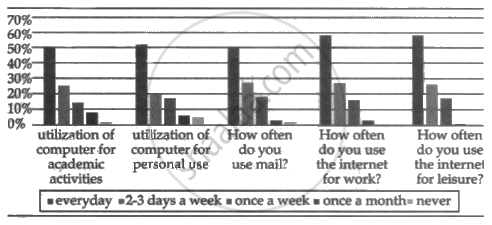 |
| (2) | At present, many schools and universities have been implementing internet-based learning, as it supplements the conventional teaching methods. The internet provides a wide variety of references and information to academics as well as scientific researchers. Students often turn to it to do their academic assignments and projects. |
| (3) | However, research on Internet is very different from traditional library research, and the differences can cause problems. The Internet is a tremendous resource, but it must be used carefully and critically. |
| (4) | According to a 2018 Academic Student e-book Experience Survey, conducted by LJ' s research department and sponsored by EBSCO, when reading for pleasure, almost 74% of respondents said they preferred print books for leisure whereas, 45 % of respondents chose e-books rather than the printed versions, for research or assignments. |
| (5) | When asked what e-book features make them their favourite for research, the respondents were clear. Having page numbers to use in citations, topped the list (75% ); followed by the ability to resize text to fit a device's screen (67%); the ability to bookmark pages, highlight text, or take notes for later reference (60% ); downloading the entire e-book (57% ); and allowing content to be transferred between devices (43%) were the varied responses. |
Arrange the given e-book features preferred for research from the least favourite to the most favourite-
- downloading the entire e-book
- choosing page numbers in citations
- highlighting text
- resizing text to fit screen
Concept: undefined >> undefined
Advertisements
| I struck at the water as I went down, expending my strength as one in a nightmare fights an irresistible force. I had lost all my breath. My lungs ached, my head throbbed. I was getting dizzy. But I remembered the strategy — I would spring from the bottom of the pool and come like a cork to the surface. I would lie flat on the water, strike out with my arms, and thrash with my legs. Then I would get to the edge of the pool and be safe. I went down, down, endlessly. I opened my eyes. Nothing but water with a yellow glow — dark water that one could not see through. And then sheer, stark terror seized me, terror, that knows no understanding, terror that knows no control, terror that no one can understand who has not experienced it. I was shrieking underwater. I was paralysed under water — stiff, rigid with fear. Even the screams in my throat were frozen. Only my heart, and the pounding in my head, said that I was still alive. |
When the sheer, stark terror seized the author, he narrates the experience. Which of the following options is not a description of the author?
Concept: undefined >> undefined
| The Maharaja's anxiety reached a fever pitch when there remained just one tiger to achieve his tally of a hundred. He had this one thought during the day and the same dream at night. By this time the tiger farms had run dry even in his father-in-law's kingdom. It became impossible to locate tigers anywhere. Yet only one more was needed. If he could kill just that one single beast, the Maharaja would have no fears left. He could give up tiger hunting altogether. But he had to be extremely careful with that last tiger. What had the late chief astrologer said? ''Even after killing ninety-nine tigers, the Maharaja should beware of the hundredth ..." True enough. The tiger was a savage beast after all. One had to be wary of it. But where was that hundredth tiger to be found? It seemed easier to find tiger's milk than a live tiger. |
What is the objective of the passage?
Concept: undefined >> undefined
| The Maharaja's anxiety reached a fever pitch when there remained just one tiger to achieve his tally of a hundred. He had this one thought during the day and the same dream at night. By this time the tiger farms had run dry even in his father-in-law's kingdom. It became impossible to locate tigers anywhere. Yet only one more was needed. If he could kill just that one single beast, the Maharaja would have no fears left. He could give up tiger hunting altogether. But he had to be extremely careful with that last tiger. What had the late chief astrologer said? ''Even after killing ninety-nine tigers, the Maharaja should beware of the hundredth ..." True enough. The tiger was a savage beast after all. One had to be wary of it. But where was that hundredth tiger to be found? It seemed easier to find tiger's milk than a live tiger. |
From this line: 'By this time the tiger farms had run dry even in his father-in-law's kingdom' - what can you guess about the Maharaja's mission to fulfil killing the hundredth tiger?
Concept: undefined >> undefined
| The Maharaja's anxiety reached a fever pitch when there remained just one tiger to achieve his tally of a hundred. He had this one thought during the day and the same dream at night. By this time the tiger farms had run dry even in his father-in-law's kingdom. It became impossible to locate tigers anywhere. Yet only one more was needed. If he could kill just that one single beast, the Maharaja would have no fears left. He could give up tiger hunting altogether. But he had to be extremely careful with that last tiger. What had the late chief astrologer said? ''Even after killing ninety-nine tigers, the Maharaja should beware of the hundredth ..." True enough. The tiger was a savage beast after all. One had to be wary of it. But where was that hundredth tiger to be found? It seemed easier to find tiger's milk than a live tiger. |
Read the line: 'If he could kill just that one single beast, the Maharaja would have no fears left.' What are the 'fears' referred to here?
Concept: undefined >> undefined
| The Maharaja's anxiety reached a fever pitch when there remained just one tiger to achieve his tally of a hundred. He had this one thought during the day and the same dream at night. By this time the tiger farms had run dry even in his father-in-law's kingdom. It became impossible to locate tigers anywhere. Yet only one more was needed. If he could kill just that one single beast, the Maharaja would have no fears left. He could give up tiger hunting altogether. But he had to be extremely careful with that last tiger. What had the late chief astrologer said? ''Even after killing ninety-nine tigers, the Maharaja should beware of the hundredth ..." True enough. The tiger was a savage beast after all. One had to be wary of it. But where was that hundredth tiger to be found? It seemed easier to find tiger's milk than a live tiger. |
What kind of beast was the tiger?
Concept: undefined >> undefined
| The Maharaja's anxiety reached a fever pitch when there remained just one tiger to achieve his tally of a hundred. He had this one thought during the day and the same dream at night. By this time the tiger farms had run dry even in his father-in-law's kingdom. It became impossible to locate tigers anywhere. Yet only one more was needed. If he could kill just that one single beast, the Maharaja would have no fears left. He could give up tiger hunting altogether. But he had to be extremely careful with that last tiger. What had the late chief astrologer said? ''Even after killing ninety-nine tigers, the Maharaja should beware of the hundredth ..." True enough. The tiger was a savage beast after all. One had to be wary of it. But where was that hundredth tiger to be found? It seemed easier to find tiger's milk than a live tiger. |
What prediction did the late chief astrologer make?
Concept: undefined >> undefined
| (1) | When you grow up in a place where it rains for five months a year, wise elders help you to get acquainted with the rain early. They teach you that it is ignorance to think that it is the same rain falling every day. Oh no! the rain is always doing different things at different times. There is rain that is gentle, and there is also rain that falls too hard and damages the crops. Hence, pray for the sweet rain that helps the crops to grow. |
| (2) | The monsoon in the Naga Hills goes by the native name, I<huthotei (which means the rice- growing season). It lasts from May to early or mid-October. The local residents firmly believe that Durga Puja in October announces the end to rain. After that, one might expect a couple of short winter showers, and the spring showers in March and April. Finally, comes the 'big rain' in May; proper rainstorms accompanied by heart-stopping lightning and ear-splitting thunder. I have stood out in storms looking at lightning arc across the dark skies, a light-and-sound show that can go on for hours. |
| (3) | This is the season when people use the word 'sezuo' and 'suzu' to refer to the week-long rains, when clothes don't dry and smell of mould, when fungus forms on the floor and you can't see the moon or the stars. |
| (4) | The rains are also called after flowering plants and people believe that the blossoming of those plants draws out rain. Once the monsoon sets in, field work is carried out in earnest and the work of uprooting and transplanting paddy in flooded fields is done. The months of hard labour are June, July and August. In August, as the phrogo plant begins to bloom, a rain will fall. This August rain, also called phrogo, is a sign that the time for cultivation is over. If any new grain seeds are sown, they may not sprout; even if they do sprout, they are not likely to bear grain. The rain acts as a kind of farmer's almanac. |
| (5) | The urban population of school-goers and office-goers naturally dislikes the monsoon and its accompanying problems of landslides, muddy, streets and periodic infections. For non-farmers, the month of September can be depressing, when the rainfall is incessant and the awareness persists that the monsoons will last out till October. One needs to have the heart of a farmer to remain grateful for the watery days, and be able to observe from what seems to the inexperienced as a continuous downpour-many kinds of rain. Some of the commonly known rain-weeks are named after the plants that alternately bloom in August and September. The native belief is that the flowers draw out the rain. |
| (6) | Each rain period has a job to fulfil: October rain helps garlic bulbs to form, while kumunyo rain helps the rice bear grain. Without it, the ears of rice cannot form properly. End of October is the most beautiful month in the Naga Hills, as the fields turn gold and wild sunflowers bloom over the slopes, all heralding the harvest. Prayers go up for protecting the fields from storms, and the rains to retreat because the grains need to stand in the sun and ripen. The cycle nears completion a few weeks before the harvest, and the rain does retreat so thoroughly from the reaped furrows that the earth quickly turns hard. The months of rain becomes a distant memory until it starts all over again. |
The rains are called after flowering plants because ______.
Concept: undefined >> undefined
| (1) | When you grow up in a place where it rains for five months a year, wise elders help you to get acquainted with the rain early. They teach you that it is ignorance to think that it is the same rain falling every day. Oh no! the rain is always doing different things at different times. There is rain that is gentle, and there is also rain that falls too hard and damages the crops. Hence, pray for the sweet rain that helps the crops to grow. |
| (2) | The monsoon in the Naga Hills goes by the native name, Khuthotei (which means the rice- growing season). It lasts from May to early or mid-October. The local residents firmly believe that Durga Puja in October announces the end to rain. After that, one might expect a couple of short winter showers, and the spring showers in March and April. Finally, comes the 'big rain' in May; proper rainstorms accompanied by heart-stopping lightning and ear-splitting thunder. I have stood out in storms looking at lightning arc across the dark skies, a light-and-sound show that can go on for hours. |
| (3) | This is the season when people use the word 'sezuo' and 'suzu' to refer to the week-long rains, when clothes don't dry and smell of mould, when fungus forms on the floor and you can't see the moon or the stars. |
| (4) | The rains are also called after flowering plants and people believe that the blossoming of those plants draws out rain. Once the monsoon sets in, field work is carried out in earnest and the work of uprooting and transplanting paddy in flooded fields is done. The months of hard labour are June, July and August. In August, as the phrogo plant begins to bloom, a rain will fall. This August rain, also called phrogo, is a sign that the time for cultivation is over. If any new grain seeds are sown, they may not sprout; even if they do sprout, they are not likely to bear grain. The rain acts as a kind of farmer's almanac. |
| (5) | The urban population of school-goers and office-goers naturally dislikes the monsoon and its accompanying problems of landslides, muddy, streets and periodic infections. For non-farmers, the month of September can be depressing, when the rainfall is incessant and the awareness persists that the monsoons will last out till October. One needs to have the heart of a farmer to remain grateful for the watery days, and be able to observe from what seems to the inexperienced as a continuous downpour-many kinds of rain. Some of the commonly known rain-weeks are named after the plants that alternately bloom in August and September. The native belief is that the flowers draw out the rain. |
| (6) | Each rain period has a job to fulfil: October rain helps garlic bulbs to form, while kumunyo rain helps the rice bear grain. Without it, the ears of rice cannot form properly. End of October is the most beautiful month in the Naga Hills, as the fields turn gold and wild sunflowers bloom over the slopes, all heralding the harvest. Prayers go up for protecting the fields from storms, and the rains to retreat because the grains need to stand in the sun and ripen. The cycle nears completion a few weeks before the harvest, and the rain does retreat so thoroughly from the reaped furrows that the earth quickly turns hard. The months of rain becomes a distant memory until it starts all over again. |
People who live in cities don't like rain because ______.
Concept: undefined >> undefined
| Six hundred and fifty million years ago, a giant amalgamated southern supercontinent — Gondwana — did indeed exist, centred roughly around present-day Antarctica. Things were quite different then: humans hadn't arrived on the global scene, and the climate was much warmer, hosting a huge variety of flora and fauna. For 500 million years Gondwana thrived, but around the time when the dinosaurs were wiped out and the age of the mammals got underway, the landmass was forced to separate into countries, shaping the globe much as we know it today. |
From the passage, it could be understood that Gondwana was a ______.
Concept: undefined >> undefined
| (1) | When you grow up in a place where it rains for five months a year, wise elders help you to get acquainted with the rain early. They teach you that it is ignorance to think that it is the same rain falling every day. Oh no! the rain is always doing different things at different times. There is rain that is gentle, and there is also rain that falls too hard and damages the crops. Hence, pray for the sweet rain that helps the crops to grow. |
| (2) | The monsoon in the Naga Hills goes by the native name, I<huthotei (which means the rice- growing season). It lasts from May to early or mid-October. The local residents firmly believe that Durga Puja in October announces the end to rain. After that, one might expect a couple of short winter showers, and the spring showers in March and April. Finally, comes the 'big rain' in May; proper rainstorms accompanied by heart-stopping lightning and ear-splitting thunder. I have stood out in storms looking at lightning arc across the dark skies, a light-and-sound show that can go on for hours. |
| (3) | This is the season when people use the word 'sezuo' and 'suzu' to refer to the week-long rains, when clothes don't dry and smell of mould, when fungus forms on the floor and you can't see the moon or the stars. |
| (4) | The rains are also called after flowering plants and people believe that the blossoming of those plants draws out rain. Once the monsoon sets in, field work is carried out in earnest and the work of uprooting and transplanting paddy in flooded fields is done. The months of hard labour are June, July and August. In August, as the phrogo plant begins to bloom, a rain will fall. This August rain, also called phrogo, is a sign that the time for cultivation is over. If any new grain seeds are sown, they may not sprout; even if they do sprout, they are not likely to bear grain. The rain acts as a kind of farmer's almanac. |
| (5) | The urban population of school-goers and office-goers naturally dislikes the monsoon and its accompanying problems of landslides, muddy, streets and periodic infections. For non-farmers, the month of September can be depressing, when the rainfall is incessant and the awareness persists that the monsoons will last out till October. One needs to have the heart of a farmer to remain grateful for the watery days, and be able to observe from what seems to the inexperienced as a continuous downpour-many kinds of rain. Some of the commonly known rain-weeks are named after the plants that alternately bloom in August and September. The native belief is that the flowers draw out the rain. |
| (6) | Each rain period has a job to fulfil: October rain helps garlic bulbs to form, while kumunyo rain helps the rice bear grain. Without it, the ears of rice cannot form properly. End of October is the most beautiful month in the Naga Hills, as the fields turn gold and wild sunflowers bloom over the slopes, all heralding the harvest. Prayers go up for protecting the fields from storms, and the rains to retreat because the grains need to stand in the sun and ripen. The cycle nears completion a few weeks before the harvest, and the rain does retreat so thoroughly from the reaped furrows that the earth quickly turns hard. The months of rain becomes a distant memory until it starts all over again. |
What do elders want you to understand about rains?
Concept: undefined >> undefined
| Six hundred and fifty million years ago, a giant amalgamated southern supercontinent — Gondwana — did indeed exist, centred roughly around present-day Antarctica. Things were quite different then: humans hadn't arrived on the global scene, and the climate was much warmer, hosting a huge variety of flora and fauna. For 500 million years Gondwana thrived, but around the time when the dinosaurs were wiped out and the age of the mammals got underway, the landmass was forced to separate into countries, shaping the globe much as we know it today. |
According to the passage, who did not arrive on the global scene some six hundred and fifty million years ago?
Concept: undefined >> undefined
| Six hundred and fifty million years ago, a giant amalgamated southern supercontinent — Gondwana — did indeed exist, centred roughly around present-day Antarctica. Things were quite different then: humans hadn't arrived on the global scene, and the climate was much warmer, hosting a huge variety of flora and fauna. For 500 million years Gondwana thrived, but around the time when the dinosaurs were wiped out and the age of the mammals got underway, the landmass was forced to separate into countries, shaping the globe much as we know it today. |
For how many years did Gondwana thrive?
Concept: undefined >> undefined
| (1) | When you grow up in a place where it rains for five months a year, wise elders help you to get acquainted with the rain early. They teach you that it is ignorance to think that it is the same rain falling every day. Oh no! the rain is always doing different things at different times. There is rain that is gentle, and there is also rain that falls too hard and damages the crops. Hence, pray for the sweet rain that helps the crops to grow. |
| (2) | The monsoon in the Naga Hills goes by the native name, I<huthotei (which means the rice- growing season). It lasts from May to early or mid-October. The local residents firmly believe that Durga Puja in October announces the end to rain. After that, one might expect a couple of short winter showers, and the spring showers in March and April. Finally, comes the 'big rain' in May; proper rainstorms accompanied by heart-stopping lightning and ear-splitting thunder. I have stood out in storms looking at lightning arc across the dark skies, a light-and-sound show that can go on for hours. |
| (3) | This is the season when people use the word 'sezuo' and 'suzu' to refer to the week-long rains, when clothes don't dry and smell of mould, when fungus forms on the floor and you can't see the moon or the stars. |
| (4) | The rains are also called after flowering plants and people believe that the blossoming of those plants draws out rain. Once the monsoon sets in, field work is carried out in earnest and the work of uprooting and transplanting paddy in flooded fields is done. The months of hard labour are June, July and August. In August, as the phrogo plant begins to bloom, a rain will fall. This August rain, also called phrogo, is a sign that the time for cultivation is over. If any new grain seeds are sown, they may not sprout; even if they do sprout, they are not likely to bear grain. The rain acts as a kind of farmer's almanac. |
| (5) | The urban population of school-goers and office-goers naturally dislikes the monsoon and its accompanying problems of landslides, muddy, streets and periodic infections. For non-farmers, the month of September can be depressing, when the rainfall is incessant and the awareness persists that the monsoons will last out till October. One needs to have the heart of a farmer to remain grateful for the watery days, and be able to observe from what seems to the inexperienced as a continuous downpour-many kinds of rain. Some of the commonly known rain-weeks are named after the plants that alternately bloom in August and September. The native belief is that the flowers draw out the rain. |
| (6) | Each rain period has a job to fulfil: October rain helps garlic bulbs to form, while kumunyo rain helps the rice bear grain. Without it, the ears of rice cannot form properly. End of October is the most beautiful month in the Naga Hills, as the fields turn gold and wild sunflowers bloom over the slopes, all heralding the harvest. Prayers go up for protecting the fields from storms, and the rains to retreat because the grains need to stand in the sun and ripen. The cycle nears completion a few weeks before the harvest, and the rain does retreat so thoroughly from the reaped furrows that the earth quickly turns hard. The months of rain becomes a distant memory until it starts all over again. |
What does Durga Puja mean to the farmers of the Naga hills?
Concept: undefined >> undefined
| Six hundred and fifty million years ago, a giant amalgamated southern supercontinent — Gondwana — did indeed exist, centred roughly around present-day Antarctica. Things were quite different then: humans hadn't arrived on the global scene, and the climate was much warmer, hosting a huge variety of flora and fauna. For 500 million years Gondwana thrived, but around the time when the dinosaurs were wiped out and the age of the mammals got underway, the landmass was forced to separate into countries, shaping the globe much as we know it today. |
When was Gondwana forced to separate into countries?
Concept: undefined >> undefined
| (1) | When you grow up in a place where it rains for five months a year, wise elders help you to get acquainted with the rain early. They teach you that it is ignorance to think that it is the same rain falling every day. Oh no! the rain is always doing different things at different times. There is rain that is gentle, and there is also rain that falls too hard and damages the crops. Hence, pray for the sweet rain that helps the crops to grow. |
| (2) | The monsoon in the Naga Hills goes by the native name, I<huthotei (which means the rice- growing season). It lasts from May to early or mid-October. The local residents firmly believe that Durga Puja in October announces the end to rain. After that, one might expect a couple of short winter showers, and the spring showers in March and April. Finally, comes the 'big rain' in May; proper rainstorms accompanied by heart-stopping lightning and ear-splitting thunder. I have stood out in storms looking at lightning arc across the dark skies, a light-and-sound show that can go on for hours. |
| (3) | This is the season when people use the word 'sezuo' and 'suzu' to refer to the week-long rains, when clothes don't dry and smell of mould, when fungus forms on the floor and you can't see the moon or the stars. |
| (4) | The rains are also called after flowering plants and people believe that the blossoming of those plants draws out rain. Once the monsoon sets in, field work is carried out in earnest and the work of uprooting and transplanting paddy in flooded fields is done. The months of hard labour are June, July and August. In August, as the phrogo plant begins to bloom, a rain will fall. This August rain, also called phrogo, is a sign that the time for cultivation is over. If any new grain seeds are sown, they may not sprout; even if they do sprout, they are not likely to bear grain. The rain acts as a kind of farmer's almanac. |
| (5) | The urban population of school-goers and office-goers naturally dislikes the monsoon and its accompanying problems of landslides, muddy, streets and periodic infections. For non-farmers, the month of September can be depressing, when the rainfall is incessant and the awareness persists that the monsoons will last out till October. One needs to have the heart of a farmer to remain grateful for the watery days, and be able to observe from what seems to the inexperienced as a continuous downpour-many kinds of rain. Some of the commonly known rain-weeks are named after the plants that alternately bloom in August and September. The native belief is that the flowers draw out the rain. |
| (6) | Each rain period has a job to fulfil: October rain helps garlic bulbs to form, while kumunyo rain helps the rice bear grain. Without it, the ears of rice cannot form properly. End of October is the most beautiful month in the Naga Hills, as the fields turn gold and wild sunflowers bloom over the slopes, all heralding the harvest. Prayers go up for protecting the fields from storms, and the rains to retreat because the grains need to stand in the sun and ripen. The cycle nears completion a few weeks before the harvest, and the rain does retreat so thoroughly from the reaped furrows that the earth quickly turns hard. The months of rain becomes a distant memory until it starts all over again. |
When can one see sunflowers blooming all over the Naga Hills?
Concept: undefined >> undefined
| (1) | When you grow up in a place where it rains for five months a year, wise elders help you to get acquainted with the rain early. They teach you that it is ignorance to think that it is the same rain falling every day. Oh no! the rain is always doing different things at different times. There is rain that is gentle, and there is also rain that falls too hard and damages the crops. Hence, pray for the sweet rain that helps the crops to grow. |
| (2) | The monsoon in the Naga Hills goes by the native name, I<huthotei (which means the rice- growing season). It lasts from May to early or mid-October. The local residents firmly believe that Durga Puja in October announces the end to rain. After that, one might expect a couple of short winter showers, and the spring showers in March and April. Finally, comes the 'big rain' in May; proper rainstorms accompanied by heart-stopping lightning and ear-splitting thunder. I have stood out in storms looking at lightning arc across the dark skies, a light-and-sound show that can go on for hours. |
| (3) | This is the season when people use the word 'sezuo' and 'suzu' to refer to the week-long rains, when clothes don't dry and smell of mould, when fungus forms on the floor and you can't see the moon or the stars. |
| (4) | The rains are also called after flowering plants and people believe that the blossoming of those plants draws out rain. Once the monsoon sets in, field work is carried out in earnest and the work of uprooting and transplanting paddy in flooded fields is done. The months of hard labour are June, July and August. In August, as the phrogo plant begins to bloom, a rain will fall. This August rain, also called phrogo, is a sign that the time for cultivation is over. If any new grain seeds are sown, they may not sprout; even if they do sprout, they are not likely to bear grain. The rain acts as a kind of farmer's almanac. |
| (5) | The urban population of school-goers and office-goers naturally dislikes the monsoon and its accompanying problems of landslides, muddy, streets and periodic infections. For non-farmers, the month of September can be depressing, when the rainfall is incessant and the awareness persists that the monsoons will last out till October. One needs to have the heart of a farmer to remain grateful for the watery days, and be able to observe from what seems to the inexperienced as a continuous downpour-many kinds of rain. Some of the commonly known rain-weeks are named after the plants that alternately bloom in August and September. The native belief is that the flowers draw out the rain. |
| (6) | Each rain period has a job to fulfil: October rain helps garlic bulbs to form, while kumunyo rain helps the rice bear grain. Without it, the ears of rice cannot form properly. End of October is the most beautiful month in the Naga Hills, as the fields turn gold and wild sunflowers bloom over the slopes, all heralding the harvest. Prayers go up for protecting the fields from storms, and the rains to retreat because the grains need to stand in the sun and ripen. The cycle nears completion a few weeks before the harvest, and the rain does retreat so thoroughly from the reaped furrows that the earth quickly turns hard. The months of rain becomes a distant memory until it starts all over again. |
Pick up the option in which the word 'furrow' has not been used in the same way as in the passage.
Concept: undefined >> undefined
| What is immediately needed today is the establishment of a World Government or an International Federation of Mankind. It is the utmost necessity of the world today, and all those persons who wish to see all human beings happy and prosperous naturally feel it keenly. Of course, at times we feel that many of the problems of our political, social, linguistic and cultural life would come to an end if there were one Government all over the world. Travellers, businessmen, seekers of knowledge and teachers of righteousness know very well that great impediments and obstructions are faced by them when they pass from one country to another, exchange goods, get information, and make an effort to spread their good gospel among their fellow-men. In the past, religious sects divided one set of people against another, colour of the skin or shape of the body set one against the other. But today when philosophical light has exploded the darkness that was created by religious differences, and when scientific knowledge has falsified the superstitions, they have enabled human beings of all religious views and of all races and colours to come in frequent contact with one another. It is the governments of various countries that keep people of one country apart from those of another. They create artificial barriers, unnatural distinctions, unhealthy isolation, unnecessary fears and dangers in the minds of the common men who by their nature want to live in friendship with their fellow men. But all these evils would cease to exist if there were one Government all over the world. |
What divides people of a country against another?
Concept: undefined >> undefined
| What is immediately needed today is the establishment of a World Government or an International Federation of Mankind. It is the utmost necessity of the world today, and all those persons who wish to see all human beings happy and prosperous naturally feel it keenly. Of course, at times we feel that many of the problems of our political, social, linguistic and cultural life would come to an end if there were one Government all over the world. Travellers, businessmen, seekers of knowledge and teachers of righteousness know very well that great impediments and obstructions are faced by them when they pass from one country to another, exchange goods, get information, and make an effort to spread their good gospel among their fellow-men. In the past, religious sects divided one set of people against another, colour of the skin or shape of the body set one against the other. But today when philosophical light has exploded the darkness that was created by religious differences, and when scientific knowledge has falsified the superstitions, they have enabled human beings of all religious views and of all races and colours to come in frequent contact with one another. It is the governments of various countries that keep people of one country apart from those of another. They create artificial barriers, unnatural distinctions, unhealthy isolation, unnecessary fears and dangers in the minds of the common men who by their nature want to live in friendship with their fellow men. But all these evils would cease to exist if there were one Government all over the world. |
What will the world Government be expected to do?
Concept: undefined >> undefined
