Advertisements
Advertisements
| ''All those who are born will one day have to die. We don't need your predictions to know that. There would be some sense in it if you could tell us the manner of that death," the royal infant uttered these words in his little squeaky voice. The chief astrologer placed his finger on his nose in wonder. A baby barely ten days old opens its lips in speech! Not only that, it also raises intelligent questions! Incredible! Rather like the bulletins issued by the war office, than facts. The chief astrologer took his finger off his nose and fixed his eyes upon the little prince. ''The prince was born in the hour of the Bull. The Bull and the Tiger are enemies, therefore, death comes from the Tiger," he explained. |
Upon taking his finger off his nose, what did the chief astrologer do?
Concept: undefined >> undefined
| (1) | We sit in the last row, bumped about but free of stares. The bus rolls out of the dull crossroads of the city, and we are soon in open countryside with fields of sunflowers as far as the eye can see, their heads all facing us. Where there is no water, the land reverts to desert. While still on level ground, we see in the distance the tall range of the Mount Bogda, abrupt like a shining prism laid horizontally on the desert surface. It is over 5,000 metres high, and the peak is under permanent snow, . in powerful contrast to the flat desert all around. Heaven Lake lies part of the way up this range, about 2,000 metres above sea level, at the foot of one of the highest snow- peaks. |
| (2) | As the bus climbs, the sky, brilliant before, grows overcast. I have brought nothing warm to wear. It is all down at the hotel in Urumqi. Rain begins to fall. The man behind me is eating overpoweringly smelly goat's cheese. The bus window leaks inhospitably, but reveals a beautiful view. We have passed quickly from desert through arable land to pasture and the ground is now green with grass, the slopes dark with pine. A few cattle drink at a clear stream flowing past moss-covered stones; it is a constable landscape. The stream changes into a white torrent, and as we climb higher, I wish more and more that I had brought with me something warmer than just the pair of shorts that have served me so well in the desert. The stream (which, we are told, rises in Heaven Lake) disappears, and we continue our slow ascent. About noon, we arrive at Heaven Lake, and look for a place to stay at the foot, which is the resort area. We get a room in a small cottage, and I am happy to note that there are thick quilts on the beds. |
| (3) | Standing outside the cottage, we survey our surroundings. Heaven Lake is long, sardine- shaped and fed by snow melt from a stream at its head. The lake is intense blue, surrounded on all sides by green mountain walls, dotted with distant steep. At the head of the lake, beyond the delta of the in-flowing stream, is a massive snow-capped peak which dominates the vista; it is part of a series of peaks that culminate, a little out of view, in Mount Bogda itself. |
| (4) | For those who live in the resort, there is a small hall by the shore. We eat here sometimes, and sometimes buy food from the vendors outside, who sell kabab and naan until the last buses leave. The kababs, cooked on skewers over charcoal braziers, are particularly good, highly spiced and well done. Horse's milk is available too from the local Kazakh herdsmen, but I decline this. I am so affected by the cold that Mr. Cao, the relaxed young man who runs the mess, lends me a spare pair of trousers, several sizes too large but more than comfortable. |
Find word from the passage which means the same as 'sellers' (Para 4)
Concept: undefined >> undefined
Advertisements
| (1) | We sit in the last row, bumped about but free of stares. The bus rolls out of the dull crossroads of the city, and we are soon in open countryside with fields of sunflowers as far as the eye can see, their heads all facing us. Where there is no water, the land reverts to desert. While still on level ground, we see in the distance the tall range of the Mount Bogda, abrupt like a shining prism laid horizontally on the desert surface. It is over 5,000 metres high, and the peak is under permanent snow, . in powerful contrast to the flat desert all around. Heaven Lake lies part of the way up this range, about 2,000 metres above sea level, at the foot of one of the highest snow- peaks. |
| (2) | As the bus climbs, the sky, brilliant before, grows overcast. I have brought nothing warm to wear. It is all down at the hotel in Urumqi. Rain begins to fall. The man behind me is eating overpoweringly smelly goat's cheese. The bus window leaks inhospitably, but reveals a beautiful view. We have passed quickly from desert through arable land to pasture and the ground is now green with grass, the slopes dark with pine. A few cattle drink at a clear stream flowing past moss-covered stones; it is a constable landscape. The stream changes into a white torrent, and as we climb higher, I wish more and more that I had brought with me something warmer than just the pair of shorts that have served me so well in the desert. The stream (which, we are told, rises in Heaven Lake) disappears, and we continue our slow ascent. About noon, we arrive at Heaven Lake, and look for a place to stay at the foot, which is the resort area. We get a room in a small cottage, and I am happy to note that there are thick quilts on the beds. |
| (3) | Standing outside the cottage, we survey our surroundings. Heaven Lake is long, sardine- shaped and fed by snow melt from a stream at its head. The lake is intense blue, surrounded on all sides by green mountain walls, dotted with distant steep. At the head of the lake, beyond the delta of the in-flowing stream, is a massive snow-capped peak which dominates the vista; it is part of a series of peaks that culminate, a little out of view, in Mount Bogda itself. |
| (4) | For those who live in the resort, there is a small hall by the shore. We eat here sometimes, and sometimes buy food from the vendors outside, who sell kabab and naan until the last buses leave. The kababs, cooked on skewers over charcoal braziers, are particularly good, highly spiced and well done. Horse's milk is available too from the local Kazakh herdsmen, but I decline this. I am so affected by the cold that Mr. Cao, the relaxed young man who runs the mess, lends me a spare pair of trousers, several sizes too large but more than comfortable. |
Pick the option which is INCORRECT.
Concept: undefined >> undefined
| ''All those who are born will one day have to die. We don't need your predictions to know that. There would be some sense in it if you could tell us the manner of that death," the royal infant uttered these words in his little squeaky voice. The chief astrologer placed his finger on his nose in wonder. A baby barely ten days old opens its lips in speech! Not only that, it also raises intelligent questions! Incredible! Rather like the bulletins issued by the war office, than facts. The chief astrologer took his finger off his nose and fixed his eyes upon the little prince. ''The prince was born in the hour of the Bull. The Bull and the Tiger are enemies, therefore, death comes from the Tiger," he explained. |
Although the speech of the prince made the chief astrologer spellbound and awestruck, what actually is the impossible paradigm stated in the passage?
Concept: undefined >> undefined
| (1) | We sit in the last row, bumped about but free of stares. The bus rolls out of the dull crossroads of the city, and we are soon in open countryside with fields of sunflowers as far as the eye can see, their heads all facing us. Where there is no water, the land reverts to desert. While still on level ground, we see in the distance the tall range of the Mount Bogda, abrupt like a shining prism laid horizontally on the desert surface. It is over 5,000 metres high, and the peak is under permanent snow, . in powerful contrast to the flat desert all around. Heaven Lake lies part of the way up this range, about 2,000 metres above sea level, at the foot of one of the highest snow- peaks. |
| (2) | As the bus climbs, the sky, brilliant before, grows overcast. I have brought nothing warm to wear. It is all down at the hotel in Urumqi. Rain begins to fall. The man behind me is eating overpoweringly smelly goat's cheese. The bus window leaks inhospitably, but reveals a beautiful view. We have passed quickly from desert through arable land to pasture and the ground is now green with grass, the slopes dark with pine. A few cattle drink at a clear stream flowing past moss-covered stones; it is a constable landscape. The stream changes into a white torrent, and as we climb higher, I wish more and more that I had brought with me something warmer than just the pair of shorts that have served me so well in the desert. The stream (which, we are told, rises in Heaven Lake) disappears, and we continue our slow ascent. About noon, we arrive at Heaven Lake, and look for a place to stay at the foot, which is the resort area. We get a room in a small cottage, and I am happy to note that there are thick quilts on the beds. |
| (3) | Standing outside the cottage, we survey our surroundings. Heaven Lake is long, sardine- shaped and fed by snow melt from a stream at its head. The lake is intense blue, surrounded on all sides by green mountain walls, dotted with distant steep. At the head of the lake, beyond the delta of the in-flowing stream, is a massive snow-capped peak which dominates the vista; it is part of a series of peaks that culminate, a little out of view, in Mount Bogda itself. |
| (4) | For those who live in the resort, there is a small hall by the shore. We eat here sometimes, and sometimes buy food from the vendors outside, who sell kabab and naan until the last buses leave. The kababs, cooked on skewers over charcoal braziers, are particularly good, highly spiced and well done. Horse's milk is available too from the local Kazakh herdsmen, but I decline this. I am so affected by the cold that Mr. Cao, the relaxed young man who runs the mess, lends me a spare pair of trousers, several sizes too large but more than comfortable. |
What does the word 'pasture' (Para 2) mean in the passage?
Concept: undefined >> undefined
| (1) | Suspense was over when my high school results finally came out. But I was upset. I hadn't done as well as I had expected. My father tried to console me. 'Why are you worried? You have done very well my dear'. 'No, I haven't, Baba,' I protested, controlling my tears, and wondering if I had disappointed him. 'It doesn't really matter,' he assured me. 'Do you know what I got when I finished high school ?' I looked into Baba's face and waited for the answer to his own question. 'You know,' he told me. 'I've never told you this. I got just a third division. But, look at me, I've done quite well. Baba got the third division! I was almost in shock, but the thought of my having done a lot better than that made me realize that I had no reason to complain. I certainly felt better! 'Everything is under control!' said Baba, smiling. That was his favourite phrase. Posted in Kolkata, my father was then a senior official in the Indian Railway Service, and an expert in goods traffic operations. He was soon to become a director with the Railway Board. By the time he retired in 1981, he was the General Manager of the Central Railways. By the time Baba passed away in November 2000, his name had found place in several hearts as well. He was open, easy to know, and full of life. We were extremely close, but I had so much more to learn about him from many things I came to know after his death. |
| (2) | In September 2000, he was in hospital for treatment of cancer and given just two months to live. When he found out, his reaction was an extremely rational one. He asked me to fetch files from his cupboard, so that he could explain the details of my mother's pension. He also dictated his will from his hospital bed. 'Everything is under control !' After Baba's death, Satish, our old family retainer, was inconsolable. We tried to cheer him up. 'Your Baba had scolded me only once in all these years!' he cried. Satish pointed to the watch on his left hand. 'I had been coming late for work and everyone in the family was complaining about it,' said Satish. 'Then, one day, your Baba gave me this watch and told me, 'now that you have a watch, you can't be late'. That was the scolding Satish received. On the fourth day after Baba's death, my sister and I had to perform a ceremony. Since several relatives were expected, we decided to order lunch from a caterer in our locality, who was reputed for his home cooked food. But, when we went to pay the owner, we got a surprise. He refused to accept any money! 'When I wanted to start my catering business, it was your father who lent me money,' he told us. It seems Baba never asked for it back. Now, after four or five years, the caterer wanted to repay that debt. Of course, we made him accept the full payment for the fine food and service. 'It was Baba's gift and it ought to remain so,' I told him. |
| (3) | Some days later, (as we were preparing for the main ceremony) there was yet another piece of information. Vikram, my brother drove me to the local market. On recognizing our car, the parking assistant, in his twenties, came running towards us and asked why he had not seen its owner for long. We had to break the news to him and to our utter surprise, he started crying. We were really surprised by this reaction from a stranger-until the man told us that Baba used to pay his daughter's school fees and buy her books. It seems it was on my father's advice that he'd even started sending the child to school. More than three years after Baba's death, as we were looking into Baba's personal things, we came across an old file with Baba's certificates and I found among them, his high school diploma from 1937, the one he'd told me about 30 years earlier, about the third division that had made no difference in his life or career. It had made me see beyond mere marks and first classes as the main road to success. But there was one more fact. Baba had actually got a first division, a rare achievement in his day. Today, years after his passing, when I think of Baba, I see a man who was able to sympathise with others very easily and who had touched their lives in some very special way. |
On knowing the result, how did the narrator's father react?
Concept: undefined >> undefined
| Crown prince Jung Jung Bahadur grew taller and stronger day by day. No other miracle marked his childhood days apart from the event already described. The boy drank the milk of an English cow, was brought up by an English nanny, tutored in English by an Englishman, saw nothing but English films — exactly as the crown princes of all the other Indian states did. When he came of age at twenty, the State, which had been with the Court of Wards until then, came into his hands. But everyone in the kingdom remembered the astrologer's prediction. Many continued to discuss the matter. Slowly it came to the Maharaja's ears. There were innumerable forests in the Pratibandapuram State. They had tigers in them. The Maharaja knew the old saying. 'You may kill even a cow in self-defence'. There could certainly be no objection to killing tigers in self-defence. The Maharaja started out on a tiger hunt. |
Which of the following options, according to the passage, shows Jung Jung Bahadur's disunion with English?
Concept: undefined >> undefined
| (1) | Suspense was over when my high school results finally came out. But I was upset. I hadn't done as well as I had expected. My father tried to console me. 'Why are you worried? You have done very well my dear'. 'No, I haven't, Baba,' I protested, controlling my tears, and wondering if I had disappointed him. 'It doesn't really matter,' he assured me. 'Do you know what I got when I finished high school ?' I looked into Baba's face and waited for the answer to his own question. 'You know,' he told me. 'I've never told you this. I got just a third division. But, look at me, I've done quite well. Baba got the third division! I was almost in shock, but the thought of my having done a lot better than that made me realize that I had no reason to complain. I certainly felt better! 'Everything is under control!' said Baba, smiling. That was his favourite phrase. Posted in Kolkata, my father was then a senior official in the Indian Railway Service, and an expert in goods traffic operations. He was soon to become a director with the Railway Board. By the time he retired in 1981, he was the General Manager of the Central Railways. By the time Baba passed away in November 2000, his name had found place in several hearts as well. He was open, easy to know, and full of life. We were extremely close, but I had so much more to learn about him from many things I came to know after his death. |
| (2) | In September 2000, he was in hospital for treatment of cancer and given just two months to live. When he found out, his reaction was an extremely rational one. He asked me to fetch files from his cupboard, so that he could explain the details of my mother's pension. He also dictated his will from his hospital bed. 'Everything is under control !' After Baba's death, Satish, our old family retainer, was inconsolable. We tried to cheer him up. 'Your Baba had scolded me only once in all these years!' he cried. Satish pointed to the watch on his left hand. 'I had been coming late for work and everyone in the family was complaining about it,' said Satish. 'Then, one day, your Baba gave me this watch and told me, 'now that you have a watch, you can't be late'. That was the scolding Satish received. On the fourth day after Baba's death, my sister and I had to perform a ceremony. Since several relatives were expected, we decided to order lunch from a caterer in our locality, who was reputed for his home cooked food. But, when we went to pay the owner, we got a surprise. He refused to accept any money! 'When I wanted to start my catering business, it was your father who lent me money,' he told us. It seems Baba never asked for it back. Now, after four or five years, the caterer wanted to repay that debt. Of course, we made him accept the full payment for the fine food and service. 'It was Baba's gift and it ought to remain so,' I told him. |
| (3) | Some days later, (as we were preparing for the main ceremony) there was yet another piece of information. Vikram, my brother drove me to the local market. On recognizing our car, the parking assistant, in his twenties, came running towards us and asked why he had not seen its owner for long. We had to break the news to him and to our utter surprise, he started crying. We were really surprised by this reaction from a stranger-until the man told us that Baba used to pay his daughter's school fees and buy her books. It seems it was on my father's advice that he'd even started sending the child to school. More than three years after Baba's death, as we were looking into Baba's personal things, we came across an old file with Baba's certificates and I found among them, his high school diploma from 1937, the one he'd told me about 30 years earlier, about the third division that had made no difference in his life or career. It had made me see beyond mere marks and first classes as the main road to success. But there was one more fact. Baba had actually got a first division, a rare achievement in his day. Today, years after his passing, when I think of Baba, I see a man who was able to sympathise with others very easily and who had touched their lives in some very special way. |
Choose the option that is not correct.
Concept: undefined >> undefined
| Crown prince Jung Jung Bahadur grew taller and stronger day by day. No other miracle marked his childhood days apart from the event already described. The boy drank the milk of an English cow, was brought up by an English nanny, tutored in English by an Englishman, saw nothing but English films — exactly as the crown princes of all the other Indian states did. When he came of age at twenty, the State, which had been with the Court of Wards until then, came into his hands. But everyone in the kingdom remembered the astrologer's prediction. Many continued to discuss the matter. Slowly it came to the Maharaja's ears. There were innumerable forests in the Pratibandapuram State. They had tigers in them. The Maharaja knew the old saying. 'You may kill even a cow in self-defence'. There could certainly be no objection to killing tigers in self-defence. The Maharaja started out on a tiger hunt. |
What Happened when Jung Jung Bahadur reached the age of twenty?
Concept: undefined >> undefined
| (1) | Suspense was over when my high school results finally came out. But I was upset. I hadn't done as well as I had expected. My father tried to console me. 'Why are you worried? You have done very well my dear'. 'No, I haven't, Baba,' I protested, controlling my tears, and wondering if I had disappointed him. 'It doesn't really matter,' he assured me. 'Do you know what I got when I finished high school ?' I looked into Baba's face and waited for the answer to his own question. 'You know,' he told me. 'I've never told you this. I got just a third division. But, look at me, I've done quite well. Baba got the third division! I was almost in shock, but the thought of my having done a lot better than that made me realize that I had no reason to complain. I certainly felt better! 'Everything is under control!' said Baba, smiling. That was his favourite phrase. Posted in Kolkata, my father was then a senior official in the Indian Railway Service, and an expert in goods traffic operations. He was soon to become a director with the Railway Board. By the time he retired in 1981, he was the General Manager of the Central Railways. By the time Baba passed away in November 2000, his name had found place in several hearts as well. He was open, easy to know, and full of life. We were extremely close, but I had so much more to learn about him from many things I came to know after his death. |
| (2) | In September 2000, he was in hospital for treatment of cancer and given just two months to live. When he found out, his reaction was an extremely rational one. He asked me to fetch files from his cupboard, so that he could explain the details of my mother's pension. He also dictated his will from his hospital bed. 'Everything is under control !' After Baba's death, Satish, our old family retainer, was inconsolable. We tried to cheer him up. 'Your Baba had scolded me only once in all these years!' he cried. Satish pointed to the watch on his left hand. 'I had been coming late for work and everyone in the family was complaining about it,' said Satish. 'Then, one day, your Baba gave me this watch and told me, 'now that you have a watch, you can't be late'. That was the scolding Satish received. On the fourth day after Baba's death, my sister and I had to perform a ceremony. Since several relatives were expected, we decided to order lunch from a caterer in our locality, who was reputed for his home cooked food. But, when we went to pay the owner, we got a surprise. He refused to accept any money! 'When I wanted to start my catering business, it was your father who lent me money,' he told us. It seems Baba never asked for it back. Now, after four or five years, the caterer wanted to repay that debt. Of course, we made him accept the full payment for the fine food and service. 'It was Baba's gift and it ought to remain so,' I told him. |
| (3) | Some days later, (as we were preparing for the main ceremony) there was yet another piece of information. Vikram, my brother drove me to the local market. On recognizing our car, the parking assistant, in his twenties, came running towards us and asked why he had not seen its owner for long. We had to break the news to him and to our utter surprise, he started crying. We were really surprised by this reaction from a stranger-until the man told us that Baba used to pay his daughter's school fees and buy her books. It seems it was on my father's advice that he'd even started sending the child to school. More than three years after Baba's death, as we were looking into Baba's personal things, we came across an old file with Baba's certificates and I found among them, his high school diploma from 1937, the one he'd told me about 30 years earlier, about the third division that had made no difference in his life or career. It had made me see beyond mere marks and first classes as the main road to success. But there was one more fact. Baba had actually got a first division, a rare achievement in his day. Today, years after his passing, when I think of Baba, I see a man who was able to sympathise with others very easily and who had touched their lives in some very special way. |
Whose fees the narrator's father used to pay?
Concept: undefined >> undefined
| Crown prince Jung Jung Bahadur grew taller and stronger day by day. No other miracle marked his childhood days apart from the event already described. The boy drank the milk of an English cow, was brought up by an English nanny, tutored in English by an Englishman, saw nothing but English films — exactly as the crown princes of all the other Indian states did. When he came of age at twenty, the State, which had been with the Court of Wards until then, came into his hands. But everyone in the kingdom remembered the astrologer's prediction. Many continued to discuss the matter. Slowly it came to the Maharaja's ears. There were innumerable forests in the Pratibandapuram State. They had tigers in them. The Maharaja knew the old saying. 'You may kill even a cow in self-defence'. There could certainly be no objection to killing tigers in self-defence. The Maharaja started out on a tiger hunt. |
Who was not aware of the astrologer's prediction about Jung Jung Bahadur?
Concept: undefined >> undefined
| (1) | Suspense was over when my high school results finally came out. But I was upset. I hadn't done as well as I had expected. My father tried to console me. 'Why are you worried? You have done very well my dear'. 'No, I haven't, Baba,' I protested, controlling my tears, and wondering if I had disappointed him. 'It doesn't really matter,' he assured me. 'Do you know what I got when I finished high school ?' I looked into Baba's face and waited for the answer to his own question. 'You know,' he told me. 'I've never told you this. I got just a third division. But, look at me, I've done quite well. Baba got the third division! I was almost in shock, but the thought of my having done a lot better than that made me realize that I had no reason to complain. I certainly felt better! 'Everything is under control!' said Baba, smiling. That was his favourite phrase. Posted in Kolkata, my father was then a senior official in the Indian Railway Service, and an expert in goods traffic operations. He was soon to become a director with the Railway Board. By the time he retired in 1981, he was the General Manager of the Central Railways. By the time Baba passed away in November 2000, his name had found place in several hearts as well. He was open, easy to know, and full of life. We were extremely close, but I had so much more to learn about him from many things I came to know after his death. |
| (2) | In September 2000, he was in hospital for treatment of cancer and given just two months to live. When he found out, his reaction was an extremely rational one. He asked me to fetch files from his cupboard, so that he could explain the details of my mother's pension. He also dictated his will from his hospital bed. 'Everything is under control !' After Baba's death, Satish, our old family retainer, was inconsolable. We tried to cheer him up. 'Your Baba had scolded me only once in all these years!' he cried. Satish pointed to the watch on his left hand. 'I had been coming late for work and everyone in the family was complaining about it,' said Satish. 'Then, one day, your Baba gave me this watch and told me, 'now that you have a watch, you can't be late'. That was the scolding Satish received. On the fourth day after Baba's death, my sister and I had to perform a ceremony. Since several relatives were expected, we decided to order lunch from a caterer in our locality, who was reputed for his home cooked food. But, when we went to pay the owner, we got a surprise. He refused to accept any money! 'When I wanted to start my catering business, it was your father who lent me money,' he told us. It seems Baba never asked for it back. Now, after four or five years, the caterer wanted to repay that debt. Of course, we made him accept the full payment for the fine food and service. 'It was Baba's gift and it ought to remain so,' I told him. |
| (3) | Some days later, (as we were preparing for the main ceremony) there was yet another piece of information. Vikram, my brother drove me to the local market. On recognizing our car, the parking assistant, in his twenties, came running towards us and asked why he had not seen its owner for long. We had to break the news to him and to our utter surprise, he started crying. We were really surprised by this reaction from a stranger-until the man told us that Baba used to pay his daughter's school fees and buy her books. It seems it was on my father's advice that he'd even started sending the child to school. More than three years after Baba's death, as we were looking into Baba's personal things, we came across an old file with Baba's certificates and I found among them, his high school diploma from 1937, the one he'd told me about 30 years earlier, about the third division that had made no difference in his life or career. It had made me see beyond mere marks and first classes as the main road to success. But there was one more fact. Baba had actually got a first division, a rare achievement in his day. Today, years after his passing, when I think of Baba, I see a man who was able to sympathise with others very easily and who had touched their lives in some very special way. |
Why did he ask to bring files before his death?
Concept: undefined >> undefined
| (1) | Suspense was over when my high school results finally came out. But I was upset. I hadn't done as well as I had expected. My father tried to console me. 'Why are you worried? You have done very well my dear'. 'No, I haven't, Baba,' I protested, controlling my tears, and wondering if I had disappointed him. 'It doesn't really matter,' he assured me. 'Do you know what I got when I finished high school ?' I looked into Baba's face and waited for the answer to his own question. 'You know,' he told me. 'I've never told you this. I got just a third division. But, look at me, I've done quite well. Baba got the third division! I was almost in shock, but the thought of my having done a lot better than that made me realize that I had no reason to complain. I certainly felt better! 'Everything is under control!' said Baba, smiling. That was his favourite phrase. Posted in Kolkata, my father was then a senior official in the Indian Railway Service, and an expert in goods traffic operations. He was soon to become a director with the Railway Board. By the time he retired in 1981, he was the General Manager of the Central Railways. By the time Baba passed away in November 2000, his name had found place in several hearts as well. He was open, easy to know, and full of life. We were extremely close, but I had so much more to learn about him from many things I came to know after his death. |
| (2) | In September 2000, he was in hospital for treatment of cancer and given just two months to live. When he found out, his reaction was an extremely rational one. He asked me to fetch files from his cupboard, so that he could explain the details of my mother's pension. He also dictated his will from his hospital bed. 'Everything is under control !' After Baba's death, Satish, our old family retainer, was inconsolable. We tried to cheer him up. 'Your Baba had scolded me only once in all these years!' he cried. Satish pointed to the watch on his left hand. 'I had been coming late for work and everyone in the family was complaining about it,' said Satish. 'Then, one day, your Baba gave me this watch and told me, 'now that you have a watch, you can't be late'. That was the scolding Satish received. On the fourth day after Baba's death, my sister and I had to perform a ceremony. Since several relatives were expected, we decided to order lunch from a caterer in our locality, who was reputed for his home cooked food. But, when we went to pay the owner, we got a surprise. He refused to accept any money! 'When I wanted to start my catering business, it was your father who lent me money,' he told us. It seems Baba never asked for it back. Now, after four or five years, the caterer wanted to repay that debt. Of course, we made him accept the full payment for the fine food and service. 'It was Baba's gift and it ought to remain so,' I told him. |
| (3) | Some days later, (as we were preparing for the main ceremony) there was yet another piece of information. Vikram, my brother drove me to the local market. On recognizing our car, the parking assistant, in his twenties, came running towards us and asked why he had not seen its owner for long. We had to break the news to him and to our utter surprise, he started crying. We were really surprised by this reaction from a stranger-until the man told us that Baba used to pay his daughter's school fees and buy her books. It seems it was on my father's advice that he'd even started sending the child to school. More than three years after Baba's death, as we were looking into Baba's personal things, we came across an old file with Baba's certificates and I found among them, his high school diploma from 1937, the one he'd told me about 30 years earlier, about the third division that had made no difference in his life or career. It had made me see beyond mere marks and first classes as the main road to success. But there was one more fact. Baba had actually got a first division, a rare achievement in his day. Today, years after his passing, when I think of Baba, I see a man who was able to sympathise with others very easily and who had touched their lives in some very special way. |
Pick out the word from the passage that mean the same as 'anxiety' (Para 1)
Concept: undefined >> undefined
| Crown prince Jung Jung Bahadur grew taller and stronger day by day. No other miracle marked his childhood days apart from the event already described. The boy drank the milk of an English cow, was brought up by an English nanny, tutored in English by an Englishman, saw nothing but English films — exactly as the crown princes of all the other Indian states did. When he came of age at twenty, the State, which had been with the Court of Wards until then, came into his hands. But everyone in the kingdom remembered the astrologer's prediction. Many continued to discuss the matter. Slowly it came to the Maharaja's ears. There were innumerable forests in the Pratibandapuram State. They had tigers in them. The Maharaja knew the old saying. 'You may kill even a cow in self-defence'. There could certainly be no objection to killing tigers in self-defence. The Maharaja started out on a tiger hunt. |
How many forests were there in Pratibandapuram State?
Concept: undefined >> undefined
| Crown prince Jung Jung Bahadur grew taller and stronger day by day. No other miracle marked his childhood days apart from the event already described. The boy drank the milk of an English cow, was brought up by an English nanny, tutored in English by an Englishman, saw nothing but English films — exactly as the crown princes of all the other Indian states did. When he came of age at twenty, the State, which had been with the Court of Wards until then, came into his hands. But everyone in the kingdom remembered the astrologer's prediction. Many continued to discuss the matter. Slowly it came to the Maharaja's ears. There were innumerable forests in the Pratibandapuram State. They had tigers in them. The Maharaja knew the old saying. 'You may kill even a cow in self-defence'. There could certainly be no objection to killing tigers in self-defence. The Maharaja started out on a tiger hunt. |
What tr the objective of the Maharaja's saying the line: 'You may kill even a cow in self-defence'?
Concept: undefined >> undefined
| (1) | Suspense was over when my high school results finally came out. But I was upset. I hadn't done as well as I had expected. My father tried to console me. 'Why are you worried? You have done very well my dear'. 'No, I haven't, Baba,' I protested, controlling my tears, and wondering if I had disappointed him. 'It doesn't really matter,' he assured me. 'Do you know what I got when I finished high school ?' I looked into Baba's face and waited for the answer to his own question. 'You know,' he told me. 'I've never told you this. I got just a third division. But, look at me, I've done quite well. Baba got the third division! I was almost in shock, but the thought of my having done a lot better than that made me realize that I had no reason to complain. I certainly felt better! 'Everything is under control!' said Baba, smiling. That was his favourite phrase. Posted in Kolkata, my father was then a senior official in the Indian Railway Service, and an expert in goods traffic operations. He was soon to become a director with the Railway Board. By the time he retired in 1981, he was the General Manager of the Central Railways. By the time Baba passed away in November 2000, his name had found place in several hearts as well. He was open, easy to know, and full of life. We were extremely close, but I had so much more to learn about him from many things I came to know after his death. |
| (2) | In September 2000, he was in hospital for treatment of cancer and given just two months to live. When he found out, his reaction was an extremely rational one. He asked me to fetch files from his cupboard, so that he could explain the details of my mother's pension. He also dictated his will from his hospital bed. 'Everything is under control !' After Baba's death, Satish, our old family retainer, was inconsolable. We tried to cheer him up. 'Your Baba had scolded me only once in all these years!' he cried. Satish pointed to the watch on his left hand. 'I had been coming late for work and everyone in the family was complaining about it,' said Satish. 'Then, one day, your Baba gave me this watch and told me, 'now that you have a watch, you can't be late'. That was the scolding Satish received. On the fourth day after Baba's death, my sister and I had to perform a ceremony. Since several relatives were expected, we decided to order lunch from a caterer in our locality, who was reputed for his home cooked food. But, when we went to pay the owner, we got a surprise. He refused to accept any money! 'When I wanted to start my catering business, it was your father who lent me money,' he told us. It seems Baba never asked for it back. Now, after four or five years, the caterer wanted to repay that debt. Of course, we made him accept the full payment for the fine food and service. 'It was Baba's gift and it ought to remain so,' I told him. |
| (3) | Some days later, (as we were preparing for the main ceremony) there was yet another piece of information. Vikram, my brother drove me to the local market. On recognizing our car, the parking assistant, in his twenties, came running towards us and asked why he had not seen its owner for long. We had to break the news to him and to our utter surprise, he started crying. We were really surprised by this reaction from a stranger-until the man told us that Baba used to pay his daughter's school fees and buy her books. It seems it was on my father's advice that he'd even started sending the child to school. More than three years after Baba's death, as we were looking into Baba's personal things, we came across an old file with Baba's certificates and I found among them, his high school diploma from 1937, the one he'd told me about 30 years earlier, about the third division that had made no difference in his life or career. It had made me see beyond mere marks and first classes as the main road to success. But there was one more fact. Baba had actually got a first division, a rare achievement in his day. Today, years after his passing, when I think of Baba, I see a man who was able to sympathise with others very easily and who had touched their lives in some very special way. |
Which division did Baba actually get?
Concept: undefined >> undefined
| Mukesh's family is among them. None of them know that it is illegal for children like him to work in the glass furnaces with high temperatures, in dingy cells without air and light; that the law, if enforced, could get him and all those 20,000 children out of the hot furnaces where they slog their daylight hours, often losing the brightness of their eyes. Mukesh's eyes beam as he volunteers to take me home, which he proudly says is being rebuilt. We walk down stinking lanes choked with garbage, past homes that remain hovels with crumbling walls, wobbly doors, no windows, crowded with families of humans and animals coexisting in a primaeval state. He stops at the door of one such house, bangs a wobbly iron door with his foot, and pushes it open. We enter a half-built shack. In one part of it, thatched with dead grass, is a firewood stove over which sits a large vessel of sizzling spinach leaves. On the ground, in large aluminium platters, are more chopped vegetables. |
Which of the following sentence is not correct in context to the working of children?
Concept: undefined >> undefined
| Mukesh's family is among them. None of them know that it is illegal for children like him to work in the glass furnaces with high temperatures, in dingy cells without air and light; that the law, if enforced, could get him and all those 20,000 children out of the hot furnaces where they slog their daylight hours, often losing the brightness of their eyes. Mukesh's eyes beam as he volunteers to take me home, which he proudly says is being rebuilt. We walk down stinking lanes choked with garbage, past homes that remain hovels with crumbling walls, wobbly doors, no windows, crowded with families of humans and animals coexisting in a primaeval state. He stops at the door of one such house, bangs a wobbly iron door with his foot, and pushes it open. We enter a half-built shack. In one part of it, thatched with dead grass, is a firewood stove over which sits a large vessel of sizzling spinach leaves. On the ground, in large aluminium platters, are more chopped vegetables. |
How do children suffer working in hot furnaces?
Concept: undefined >> undefined
| Mukesh's family is among them. None of them know that it is illegal for children like him to work in the glass furnaces with high temperatures, in dingy cells without air and light; that the law, if enforced, could get him and all those 20,000 children out of the hot furnaces where they slog their daylight hours, often losing the brightness of their eyes. Mukesh's eyes beam as he volunteers to take me home, which he proudly says is being rebuilt. We walk down stinking lanes choked with garbage, past homes that remain hovels with crumbling walls, wobbly doors, no windows, crowded with families of humans and animals coexisting in a primaeval state. He stops at the door of one such house, bangs a wobbly iron door with his foot, and pushes it open. We enter a half-built shack. In one part of it, thatched with dead grass, is a firewood stove over which sits a large vessel of sizzling spinach leaves. On the ground, in large aluminium platters, are more chopped vegetables. |
In the line: 'We walk down stinking lanes choked with garbage, .....' - what does the work 'stinking' mean?
Concept: undefined >> undefined
| (1) | The present generation is well updated with the use of internet and computers. The rapid development in computer technology and increase in accessibility of the internet for academic purposes has changed the face of education for everyone associated with it. Let's look at the data arising out of a recent survey that was done to ascertain the time spent on utilisation of the computer and internet: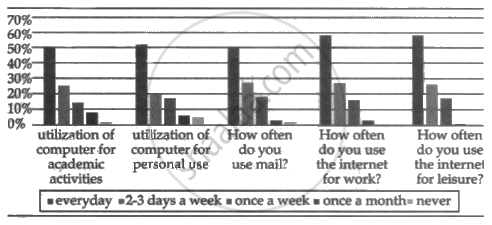 |
| (2) | At present, many schools and universities have been implementing internet-based learning, as it supplements the conventional teaching methods. The internet provides a wide variety of references and information to academics as well as scientific researchers. Students often turn to it to do their academic assignments and projects. |
| (3) | However, research on Internet is very different from traditional library research, and the differences can cause problems. The Internet is a tremendous resource, but it must be used carefully and critically. |
| (4) | According to a 2018 Academic Student e-book Experience Survey, conducted by LJ' s research department and sponsored by EBSCO, when reading for pleasure, almost 74% of respondents said they preferred print books for leisure whereas, 45 % of respondents chose e-books rather than the printed versions, for research or assignments. |
| (5) | When asked what e-book features make them their favourite for research, the respondents were clear. Having page numbers to use in citations, topped the list (75% ); followed by the ability to resize text to fit a device's screen (67%); the ability to bookmark pages, highlight text, or take notes for later reference (60% ); downloading the entire e-book (57% ); and allowing content to be transferred between devices (43%) were the varied responses. |
Choose the correctly spelt word:
Concept: undefined >> undefined
