Advertisements
Advertisements
PQRS is a parallelogram whose diagonals intersect at M.
If ∠PMS = 54°, ∠QSR = 25° and ∠SQR = 30° ; find :
(i) ∠RPS
(ii) ∠PRS
(iii) ∠PSR.
Concept: undefined >> undefined
Given: Parallelogram ABCD in which diagonals AC and BD intersect at M.
Prove: M is the mid-point of LN.
Concept: undefined >> undefined
Advertisements
ABCD is a parallelogram. What kind of quadrilateral is it if : AC = BD and AC is perpendicular to BD?
Concept: undefined >> undefined
ABCD is a parallelogram. What kind of quadrilateral is it if: AC is perpendicular to BD but is not equal to it?
Concept: undefined >> undefined
ABCD is a parallelogram. What kind of quadrilateral is it if: AC = BD but AC is not perpendicular to BD?
Concept: undefined >> undefined
Prove that the diagonals of a parallelogram bisect each other.
Concept: undefined >> undefined
In parallelogram ABCD, E is the mid-point of AD and F is the mid-point of BC. Prove that BFDE is a parallelogram.
Concept: undefined >> undefined
In parallelogram ABCD, E is the mid-point of side AB and CE bisects angle BCD. Prove that:
- AE = AD,
- DE bisects and ∠ADC and
- Angle DEC is a right angle.
Concept: undefined >> undefined
In the following diagram, the bisectors of interior angles of the parallelogram PQRS enclose a quadrilateral ABCD.
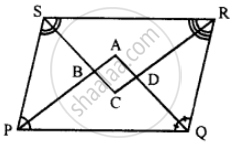
Show that:
(i) ∠PSB + ∠SPB = 90°
(ii) ∠PBS = 90°
(iii) ∠ABC = 90°
(iv) ∠ADC = 90°
(v) ∠A = 90°
(vi) ABCD is a rectangle
Thus, the bisectors of the angles of a parallelogram enclose a rectangle.
Concept: undefined >> undefined
In parallelogram ABCD, X and Y are midpoints of opposite sides AB and DC respectively. Prove that:
(i) AX = YC
(ii) AX is parallel to YC
(iii) AXCY is a parallelogram.
Concept: undefined >> undefined
The given figure shows parallelogram ABCD. Points M and N lie in diagonal BD such that DM = BN.
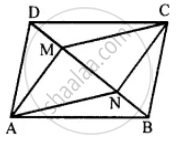
Prove that:
(i) ∆DMC = ∆BNA and so CM = AN
(ii) ∆AMD = ∆CNB and so AM CN
(iii) ANCM is a parallelogram.
Concept: undefined >> undefined
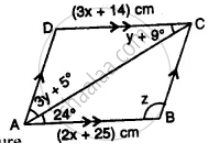
Use the information given in the alongside diagram to find the value of x, y, and z.
Concept: undefined >> undefined
In the given figure, AB || EC, AB = AC and AE bisects ∠DAC. Prove that:
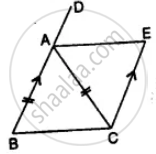
- ∠EAC = ∠ACB
- ABCE is a parallelogram.
Concept: undefined >> undefined
A cube of edge 6 cm and a cuboid with dimensions 4 cm x x cm x 15 cm are equal in volume. Find:
(i) the value of x.
(ii) the total surface area of the cuboid.
(iii) the total surface area of the cube.
(iv) which of these two has a greater surface and by how much?
Concept: undefined >> undefined
The height of a rectangular solid is 5 times its width and its length is 8 times its height. If the volume of the wall is 102.4 cm3, find its length.
Concept: undefined >> undefined
The length, breadth, and height of a cuboid (rectangular solid) are 4 : 3: 2.
(i) If its surface area is 2548 cm2, find its volume.
(ii) If its volume is 3000 m3, find its surface area.
Concept: undefined >> undefined
The height of a circular cylinder is 20 cm and the diameter of its base is 14 cm. Find:
(i) the volume
(ii) the total surface area.
Concept: undefined >> undefined
Find the curved surface area and the total surface area of a right circular cylinder whose height is 15 cm and the diameter of the cross-section is 14 cm.
Concept: undefined >> undefined
Find the height of the cylinder whose radius is 7 cm and the total surface area is 1100 cm2.
Concept: undefined >> undefined
The curved surface area of a cylinder of height 14 cm is 88 cm2. Find the diameter of the base of the cylinder.
Concept: undefined >> undefined
