Advertisements
Advertisements
What measures did Akbar adopt to reorganize and strengthen the army?
Concept: undefined >> undefined
Explain the important features of the land revenue system introduced by Todar Mal.
Concept: undefined >> undefined
Advertisements
What policies did Akbar follow to transform the Islamic state into a secular one and unite the diverse races in the country into a single nation based on equality?
Concept: undefined >> undefined
Answer the following question briefly:
Briefly explain the features and objectives of the Din- i-Ilahi?
Concept: undefined >> undefined
Mention the important features of Akbar’s Rajput policy. Why did he adopt this policy, and what were its results?
Concept: undefined >> undefined
Answer the following question briefly:
Mention any two important social reforms introduced by Akbar?
Concept: undefined >> undefined
Answer the following question briefly:
Give an account of Akbar’s cultural achievements with reference to Literature
Concept: undefined >> undefined
Answer the following question briefly:
Give an account of Akbar’s cultural achievements with reference to Architecture
Concept: undefined >> undefined
The picture depicts a Mughal emperor holding discussions on religious matters in the Ibadat Khana.
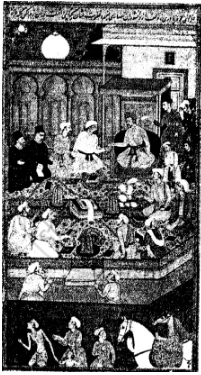
Identify the emperor.
Concept: undefined >> undefined
The picture depicts a Mughal emperor holding discussions on religious matters in the Ibadat Khana.
Which religious communities participated in the discussions?
Concept: undefined >> undefined
The picture depicts a Mughal emperor holding discussions on religious matters in the Ibadat Khana.
Why did the emperor organize these assemblies?
Concept: undefined >> undefined
The foundations laid by ______ were so strong that Jahangir did not have any major problems maintaining the empire.
Concept: undefined >> undefined
Fill in the blanks:
Chaitanya Mahaprabhu believed in ______ as the most important means of expressing__________.
Concept: undefined >> undefined
Match the contents of Column A with those of Column B:
| Column A | Column B |
| 1. Khwaja Moin-ud-din Chishti's dargah is at | (a) Talwandi |
| 2. Khwaja Nizam-ud-din Auliya's dargah is at | (b) Allahabad |
| 3. Ramanuja's birthplace is | (c) Delhi |
| 4. Ramanand was born at | (d) Ajmer |
| 5. Guru Nanak's birthplace is | (e) Apegaon |
| 6. Sant Jananeshwar was born at | (f) near Chennai |
Concept: undefined >> undefined
State whether the following statement is Ture or False:
Meerabai was an ardent devotee of Lord Krishna.
Concept: undefined >> undefined
State whether the following statement is Ture or False:
Kabir was a weaver by profession.
Concept: undefined >> undefined
State whether the following statement is Ture or False:
The Marathi devotional songs are known as kirtans.
Concept: undefined >> undefined
State whether the following statement is Ture or False:
Sant Tukaram was a contemporary of Shivaji.
Concept: undefined >> undefined
Answer the following question in one or two words/sentences:
Name the two popular Sufi orders in India.
Concept: undefined >> undefined
Answer the following question briefly:
Explain the impact of Sufism on the people and their rulers?
Concept: undefined >> undefined
