Please select a subject first
Advertisements
Advertisements
The following figure have rotational symmetry of order more than 1:
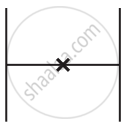
Concept: undefined >> undefined
The following figure have rotational symmetry of order more than 1.
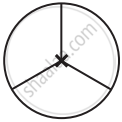
Concept: undefined >> undefined
Advertisements
The following figure have rotational symmetry of order more than 1:
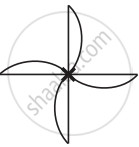
Concept: undefined >> undefined
Three cubes each with 2 cm edge are placed side by side to form a cuboid. Sketch an oblique or isometric sketch of this cuboid.
Concept: undefined >> undefined
Make an oblique sketch of the given isometric shape:
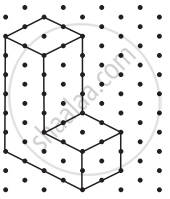
Concept: undefined >> undefined
Give an oblique sketch of the following:
A cuboid of dimensions 5 cm, 3 cm and 2 cm. (Is your sketch unique?)
Concept: undefined >> undefined
Complete the last column of the table.
| Equation | Value | Say, whether the Equation is Satisfied. (Yes/No) |
| 5x = 25 | x = 5 |
Concept: undefined >> undefined
∆ABC and ∆PQR are congruent under the correspondence:
ABC ↔ RQP
Write the parts of ∆ABC that correspond to
(i) `bar"PQ"`
(ii)∠Q
(iii) `bar"RP"`
Concept: undefined >> undefined
Write the following statement in the form of the equation:
The sum of three times x and 11 is 32.
Concept: undefined >> undefined
Write the following statement in the form of the equation:
If you subtract 5 from 6 times a number, you get 7.
Concept: undefined >> undefined
Write the following statement in the form of the equation:
One-fourth of m is 3 more than 7.
Concept: undefined >> undefined
Raju’s father’s age is 5 years more than three times Raju’s age. Raju’s father is 44 years old. Set up an equation to find Raju’s age.
Concept: undefined >> undefined
A shopkeeper sells mangoes in two types of boxes, one small and one large. A large box contains as many as 8 small boxes plus 4 loose mangoes. Set up an equation which gives the number of mangoes in each small box. The number of mangoes in a large box is given to be 100.
Concept: undefined >> undefined
Next three consecutive numbers in the pattern 11, 8, 5, 2, --, --, -- are ______.
Concept: undefined >> undefined
Water level in a well was 20 m below ground level. During rainy season, rain water collected in different water tanks was drained into the well and the water level rises 5 m above the previous level. The wall of the well is 1 m 20 cm high and a pulley is fixed at a height of 80 cm. Raghu wants to draw water from the well. The minimum length of the rope that he can use is ______.

Concept: undefined >> undefined
An atom consists of charged particles called electrons and protons. Each proton has a charge of +1 and each electron has a charge of –1. Remember number of electrons is equal to number of protons, while answering these questions:
- What is the charge on an atom?
- What will be the charge on an atom if it loses an electron?
- What will be the charge on an atom if it gains an electron?
Concept: undefined >> undefined
An atom changes to a charged particle called ion if it loses or gains electrons. The charge on an ion is the charge on electrons plus charge on protons. Now, write the missing information in the table given below:
| Name of Ion | Proton Charge | Electron Charge | Ion Charge |
| Hydroxide ion | +9 | – | –1 |
| Sodium ion | +11 | – | +1 |
| Aluminium ion | +13 | –10 | – |
| Oxide ion | +8 | –10 | – |
Concept: undefined >> undefined
Remembering that 1AD came immediately after 1BC, while solving these problems take 1BC as –1 and 1AD as +1.
- The Greeco-Roman era, when Greece and Rome ruled Egypt started in the year 330 BC and ended in the year 395 AD. How long did this era last?
- Bhaskaracharya was born in the year 1114 AD and died in the year 1185 AD. What was his age when he died?
- Turks ruled Egypt in the year 1517 AD and Queen Nefertis ruled Egypt about 2900 years before the Turks ruled. In what year did she rule?
- Greek mathematician Archimedes lived between 287 BC and 212 BC and Aristotle lived between 380 BC and 322 BC. Who lived during an earlier period?
Concept: undefined >> undefined
From given integers in Column I match an integer of Column II so that their product lies between –19 and –6:
| Column I | Column II |
| –5 | 1 |
| 6 | –1 |
| –7 | 3 |
| 8 | –2 |
Concept: undefined >> undefined
Write two integers which are smaller than –5 but their difference is –5.
Concept: undefined >> undefined
