Please select a subject first
Advertisements
Advertisements
The natural frequency (ca0) of oscillations in LC circuit is given by ______.
Concept: undefined >> undefined
A transformer works on the principle of ______.
Concept: undefined >> undefined
Advertisements
For an ideal step-down transformer, the quantity which is constant for both the coils is ______.
Concept: undefined >> undefined
An electric dipole of moment p is placed parallel to the uniform electric field. The amount of work done in rotating the dipole by 90° is ____________.
Concept: undefined >> undefined
The horizontal component of earth’s magnetic field at a place is `sqrt3` times the vertical component. The angle of dip at that place is ______.
Concept: undefined >> undefined
The small angle between magnetic axis and geographic axis at a place is ______.
Concept: undefined >> undefined
Which among the following, is not a cause for power loss in a transformer?
Concept: undefined >> undefined
Assertion(A): A magnetic needle free to rotate in a vertical plane, orients itself (with its axis) vertical at the poles of the earth.
Reason (R): At the poles of the earth the horizontal component of earth’s magnetic field will be zero.
Select the most appropriate answer from the options given below:
Concept: undefined >> undefined
Read the following paragraph and answer the question:

Long distance power transmissions
The large-scale transmission and distribution of electrical energy over long distances is done with the use of transformers. The voltage output of the generator is stepped up. It is then transmitted over long distances to an area sub-station near the consumers. There the voltage is stepped down. It is further stepped down at distributing sub-stations and utility poles before a power supply of 240 V reaches our homes.
Which of the following statement is true?
Concept: undefined >> undefined
Read the following paragraph and answer the question:
Long distance power transmissions
The large-scale transmission and distribution of electrical energy over long distances is done with the use of transformers. The voltage output of the generator is stepped up. It is then transmitted over long distances to an area sub-station near the consumers. There the voltage is stepped down. It is further stepped down at distributing sub-stations and utility poles before a power supply of 240 V reaches our homes.
If the secondary coil has a greater number of turns than the primary, ______.
Concept: undefined >> undefined
Read the following paragraph and answer the question:
Long distance power transmissions
The large-scale transmission and distribution of electrical energy over long distances is done with the use of transformers. The voltage output of the generator is stepped up. It is then transmitted over long distances to an area sub-station near the consumers. There the voltage is stepped down. It is further stepped down at distributing sub-stations and utility poles before a power supply of 240 V reaches our homes.
We need to step-up the voltage for power transmission, so that ______.
Concept: undefined >> undefined
Read the following paragraph and answer the question:
Long distance power transmissions
The large-scale transmission and distribution of electrical energy over long distances is done with the use of transformers. The voltage output of the generator is stepped up. It is then transmitted over long distances to an area sub-station near the consumers. There the voltage is stepped down. It is further stepped down at distributing sub-stations and utility poles before a power supply of 240 V reaches our homes.
A power transmission line feeds input power at 2300 V to a step down transformer with its primary windings having 4000 turns. The number of turns in the secondary in order to get output power at 230 V are ______.
Concept: undefined >> undefined
A transformer is essentially an a.c. device. It cannot work on d.c. It changes alternating voltages or currents. It does not affect the frequency of a.c. It is based on the phenomenon of mutual induction. A transformer essentially consists of two coils of insulated copper wire having different numbers of turns and wound on the same soft iron core.
The number of turns in the primary and secondary coils of an ideal transformer is 2000 and 50 respectively. The primary coil is connected to a main supply of 120 V and secondary coil is connected to a bulb of resistance 0.6 Ω.
The value of voltage across the secondary coil is ______.
Concept: undefined >> undefined
A transformer is essentially an a.c. device. It cannot work on d.c. It changes alternating voltages or currents. It does not affect the frequency of a.c. It is based on the phenomenon of mutual induction. A transformer essentially consists of two coils of insulated copper wire having different numbers of turns and wound on the same soft iron core.
The number of turns in the primary and secondary coils of an ideal transformer is 2000 and 50 respectively. The primary coil is connected to a main supply of 120 V and secondary coil is connected to a bulb of resistance 0.6 Ω.
The value of current in the bulb is ______.
Concept: undefined >> undefined
A transformer is essentially an a.c. device. It cannot work on d.c. It changes alternating voltages or currents. It does not affect the frequency of a.c. It is based on the phenomenon of mutual induction. A transformer essentially consists of two coils of insulated copper wire having different numbers of turns and wound on the same soft iron core.
The number of turns in the primary and secondary coils of an ideal transformer is 2000 and 50 respectively. The primary coil is connected to a main supply of 120 V and secondary coil is connected to a bulb of resistance 0.6 Ω.
The value of current in primary coil is ______.
Concept: undefined >> undefined
A transformer is essentially an a.c. device. It cannot work on d.c. It changes alternating voltages or currents. It does not affect the frequency of a.c. It is based on the phenomenon of mutual induction. A transformer essentially consists of two coils of insulated copper wire having different numbers of turns and wound on the same soft iron core.
The number of turns in the primary and secondary coils of an ideal transformer is 2000 and 50 respectively. The primary coil is connected to a main supply of 120 V and secondary coil is connected to a bulb of resistance 0.6 Ω.
Power in primary coil is ______.
Concept: undefined >> undefined
Two charges –q each are fixed separated by distance 2d. A third charge q of mass m placed at the mid-point is displaced slightly by x(x << d) perpendicular to the line joining the two fixed charged as shown in figure. Show that q will perform simple harmonic oscillation of time period.
`T = [(8pi^3 ε_0 md^3)/q^2]^(1/2)`
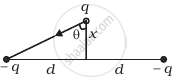
Concept: undefined >> undefined
A room has AC run for 5 hours a day at a voltage of 220V. The wiring of the room consists of Cu of 1 mm radius and a length of 10 m. Power consumption per day is 10 commercial units. What fraction of it goes in the joule heating in wires? What would happen if the wiring is made of aluminium of the same dimensions?
`[ρ_(Cu) = 1.7 xx 10_(Ωm)^-8, ρ_(Al) = 2.7 xx 10^-8 Ωm]`
Concept: undefined >> undefined
Let the magnetic field on earth be modelled by that of a point magnetic dipole at the centre of earth. The angle of dip at a point on the geographical equator ______.
- is always zero.
- can be zero at specific points.
- can be positive or negative.
- is bounded.
Concept: undefined >> undefined
Assume the dipole model for earth’s magnetic field B which is given by BV = vertical component of magnetic field = `mu_0/(4pi) (2m cos theta)/r^3` BH = Horizontal component of magnetic field = `mu_0/(4pi) (sin theta m)/r^3` θ = 90° – lattitude as measured from magnetic equator. Find loci of points for which (i) |B| is minimum; (ii) dip angle is zero and (iii) dip angle is ± 45°.
Concept: undefined >> undefined
